Britain’s busiest station is celebrating a milestone year, as Chris Milner reports.
LONDON Waterloo celebrated its 175th anniversary on July 11, when past and present railway staff came together on platform 19. Speaking at the event, Rail Minister Huw Merriman said: “This historic hub has witnessed billions of journeys and serves as a backdrop to shared memories and great adventures.”
He added: “Opening the station brought London closer to the world and the world closer to London – that’s the power rail has. Its very name carries its own historic significance, paying homage to the Battle of Waterloo.”
Originally opened by the London & South Western Railway on July 11, 1848 as Waterloo Bridge, it replaced the nearby Nine Elms station that had opened 10 years earlier.
Over the years, the station developed haphazardly, new platforms and buildings being added alongside and around the existing structures rather than as part of any overall architectural plan. Signposting within the station was poor and this often led to passengers having difficulty finding the right platform for their departure.
The current station was rebuilt from 1903 and opened in stages until finally completed in 1922, the finished design including the Victory Arch over the main entrance, a memorial to railwaymen lost in the conflicts of the First World War.
Waterloo was the last London terminus to provide steam-powered services, which ceased in 1967, while the construction of platforms 20-24 saw Eurostar trains serve the station from 1994 to 2007.
The station has remained largely unchanged since the Eurostar platforms were built, the most recent addition being the firstfloor balcony, created with escalators and lifts in July 2012 to help reduce congestion and provide step-free access to its neighbouring Waterloo East station.
Tied to history
Addressing guests, Network Rail chairman Peter Hendy outlined the part the station had played in three wars, state funerals (including that of Sir Winston Churchill) and, more recently, the arrival of 5000 armed forces personnel for the coronation of King Charles III (see June issue). He also recalled the part played by the station in the arrival of the Windrush generation, and a statue marking the 75th anniversary of the arrival of the first Caribbean migrants now stands on the concourse.
A musical interlude saw a choir of Network Rail and South Western Railway staff sing a medley of some iconic ‘Waterloo’ songs, including ABBA’s ‘Waterloo’ and The Kinks’ ‘Waterloo Sunset’.
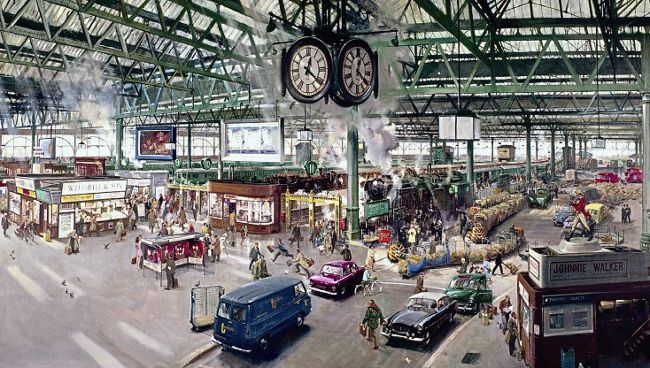
A classic late steam-era depiction of Waterloo in Terence Cuneo’s 1967 painting, which fully captures the hustle and bustle of the country’s busiest station.
TERENCE CUNEO/SCIENCE MUSEUM GROUP
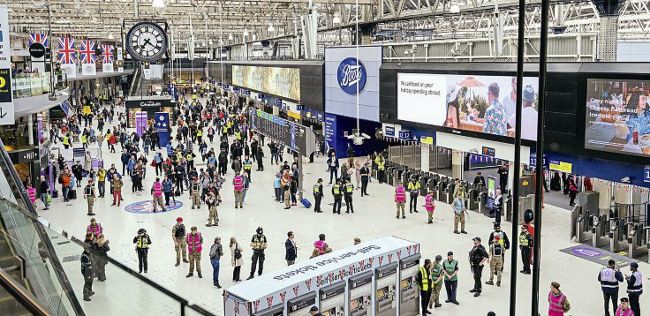
How the station looks today – the famous clock being the reference point – captured on May 6, the day that King Charles III was crowned.
JACK BOSKETT
The event also marked the opening of a fascinating exhibition under the famous concourse clock. Coordinated by career railwayman and former BR press officer Mike Lamport, the exhibition charts the development and expansion of the station over its 175 year history, and features several remarkable images, some being seen in public for the first time.
■ Guests were treated to a preview of a 10- car Class 701 ‘Arterio’ EMU, which SWR managing director Claire Mann said would be entering service ‘very soon’.
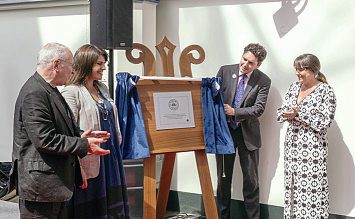
Rail Minister Huw Merryman unveils the 175th anniversary plaque at Waterloo station on July 11. With him (from left) are Lord Hendy, Claire Mann and Claire Buckley, whose father Don worked at Waterloo station for 68 of those 175 years.
CHRIS MILNER
“This historic hub has witnessed billions of journeys and serves as a backdrop to shared memories and great adventures”