KHRUANGBIN
The Texas trio’s fourth is rooted in Houston, but channeling a planet of genre-fluid grooves.
By Erin Osmon
Mordechai
DEAD OCEANS
THE UNCUT GUIDE TO THIS MONTH’S KEY RELEASES
FROM the myth of the Titan Atlas onwards, carrying the weight of the world has been perceived as a form of punishment, and a near-impossible task when posed in the mortal realm. “I ask not for lighter burdens but for broader shoulders,” a Jewish proverb declares. That one three-piece band can uphold the world’s musical legacy across a buoyant, 10-song album is quite the feat, then. How can they shoulder such multitudes? As bassist Laura Lee explains, when you’re a citizen of the world, its weight isn’t a burden, more a liberating force.
“We’re immersed in a lot of different cultures, being from Houston,” Lee says. “Because it’s a cultural melting pot, we thought that if we can make an album that sounds like the world, it would also sound like Houston.”
For their third album proper, Khruangbin - the trio of Lee, guitarist Mark Speer and drummer DJ Johnson - stitch disparate sonic touchstones from various locations worldwide to create a thoroughly modern groove, loaded with references and textures, yet blithesome and weightless in its delivery. It’s less a paint-by-numbers approach than a gentle kneading of time-tested ingredients.
The band once again tracked in analogue at their studio, known as The Farm, on Speer’s family’s land in the tiny town of Burton, Texas, where the population hovers around 400. After writing each song in the studio, the trio would capture a series of live performances. Subtle ambience lent by the breeze, and the area’s f ora and fauna, are all part of the real and living soul of Mordechai, an album so titled for a transformative experience Lee had with a friend of the same name. “There’s something really sweet and beautiful about the freshness of a new take,” Lee says. “And they’re alive because they’re recorded in a barn and not a studio. They’re not insulated from the elements. Sometimes the best take has rain or birds.”
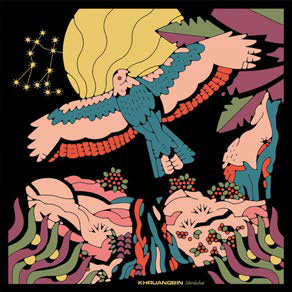
Though the album maintains the live essence of the band’s previous recordings, Lee, Speer and Johnson sing on 80 per cent of Mordechai’s songs, more than on any other Khruangbin album. Their approach to vocals is of en textural, another layer in a subtle symphony of instrumentation. “Time (You And I)” - a disco anthem that incorporates keys, pedal steel and a suite of percussive elements - features sparse vocals that recall the innocence and cheer of lost kid-soul recordings, or The Langley Schools Music Project. They are plain spoken, imperfect and totally unselfconscious. “We can play like children play/We can say like children say,” the trio sing in unison, as they jam with childlike exuberance.
The singing not only mirrors the message of the lyrics in this instance, but also the roots of Khruangbin as an instrumental band. There is enough space between words for the listener to apply their own take - be it sentimental or joyful, concrete or abstract - and the listener is not distracted by discerning the lyrical meaning but is instead entranced by the groove. Throughout Mordechai, the lyrics are not an intellectual exchange, but a visceral one. The song concludes with a series of phrases that roughly translate to “that’s life.” They’re whispered in different languages, from Hebrew to Korean to Serbian, another delicate but heady layer.
On “Pelota”, the album’s sixth track, Lee and Speer sing gently in Spanish over a mosaic of Latin percussion and syncopated hand claps, as Speer’s electric guitar flutters somewhere between South America and West Africa. In Khruangbin’s instrumental modes, Speer’s playing has of en occupied the role of singer, conveying simulated vocal melodies through his intricate and lithe picking, and lines that ring out like elegant incantations. On Mordechai, his work occupies different spaces, depending on the song’s need; in “Pelota”, it’s the lead that draws the listener into the song, just before it recedes into the background, acting as an auxiliary texture - a sort of backing vocal. On “Connaissais De Face”, it’s born of the Ethiopian songbook, somewhere between the sounds of the great Ethio-jazz composer Mulatu Astatke and singer Mahmoud Ahmed. It lives out in front, punctuating the conversational vocals, as horns of en do in Astatke and Ahmed’s work.
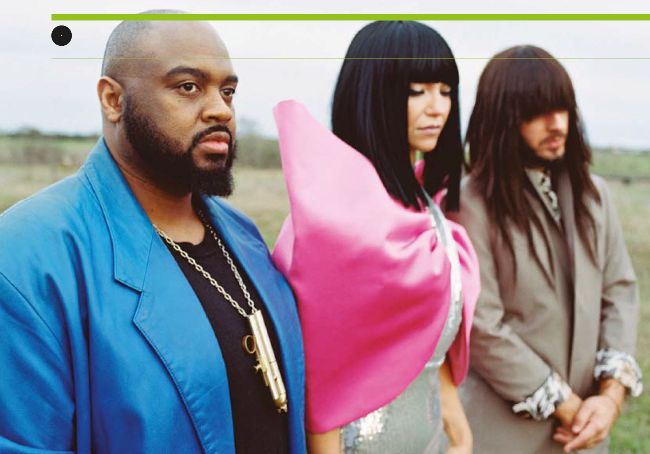
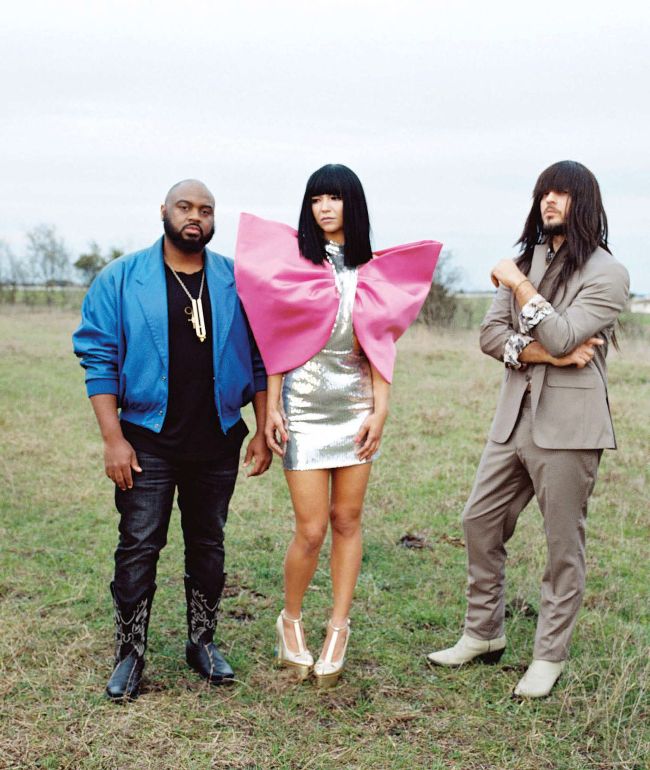
Contrasting textures: Khruangbin’s DJ Johnson, Laura Lee and Mark Speer
Scroll through the comments section on any Khruangbin video and see that much is made of the group’s locked-in quality, their distinct ability to play as a unit. The same is true on Mordechai, though the spirit of the material of en allows for more evident displays of personal flair. Johnson’s Jedi-like focus behind the drum kit - he could keep time for a metronome - is of en framed by a dynamic opening or closing break, as heard on “One To Remember”, a reggae-inspired slow burner, “Pelota” and “Connaissais De Face”. He opens “So We Won’t Forget” with a few spirited hits before joining Lee to form a dynamic, rhythmic machine. Instrumental music is not for everyone, nor is “world music”, but with Mordechai, Khruangbin have flung open the door to wider appeal with their most seamless display of genre-melding yet. As with The Avalanches’ Since I Lef You, or Michael Kiwanuka’s Kiwanuka, there’s a studiousness and a reverence for the sounds the album draws from and updates; but at the same time, there is no sense of gatekeeping, no sense that the listener is being tested.
Mordechai instead teems with the joy that comes with musical discovery, the urge to evangelise to anyone who might listen. Think of the rush that comes with hearing a brilliant international record for the first time, one largely unknown to English-speaking listeners - it’s why David Byrne started his Luaka Bop label in 1988, and why Lee, Johnson and Speer exist as Khruangbin. They’re sharing the feeling they got from that lost Brazilian psych-rock album, or from hearing that Turkish pop diva unknown to western audiences, through music that’s singular in its point of view, and strong in its cultural identity. Mordechai is a great record, made by deep listeners who believe that discerning taste does not equate to snobbishness. Through it, we’re reminded that good music is for everyone.
SLEEVE NOTES
1 First Class
2 Time (You And I)
3 Connaissais De Face
4 Father Bird, Mother Bird
5 If There Is No Question
6 Pelota
7 One To Remember
8 Dearest Alfred
9 So We Won’t Forget
10 Shida
Produced by:
Khruangbin and Steve Christensen
Recorded at:
The Farm, Burton, Texas, and Terminal C, Houston, Texas
Personnel includes: Laura Lee (electric bass, vocals), DJ Johnson (drums, Rhodeselectric piano, vocals), MarkSpeer (electric guitar, percussion, Minimoog, Mellotron, Farfisa organ, vocals), Chase Jordan (vibraphone), Will Van Horn (pedal steel), Charlie Perez (conga, bongo, quica, flexatone, shaker, timbale, pandiero, dumbek),Cleo "Pookie" Sample (Minimoog, Hammond organ), JohnAdams (rototoms)
HOW TO BUY...
TODO EL MUNDO
Three records that inspired
Mordechai
JUSTINE AND THE VICTORIAN PUNKS
“Beautiful Dreamer”/
"Still You"
COLETTE IS DEADCOLTD, 1979
A collaboration between a French-Tunisian performance artist known as Colette, and Peter Gordon & Love of Life Orchestra, a troupe of pop-loving avantgarde musicians, this NYC dance-punk single (reissued by DFA a decade ago) in part inspired the conversational vocal sty ie of "Connaissais De Face". "It’s the other French connection," Leesays.
NAZIA & ZOHEB HASSAN
Star
HISMASTER’S VOICE, 1982
Brother-sister Pakistani pop icons Nazia and Zoheb Hasson’s 1982 album soundtracked the Bollywood film Star. A blend of eastern and western sounds, it’s an early milestone in the canon of South Asian disco and electronica. "The producer [B/ddu] was trying to doa Donna Summer-Giorgio Moroder kind of thing," Lee explains.
EL FARY
El Fary
MOVIEPLAY, 1979
The Spanish singer and actor Jose Luis Cantero I Rada adopted hisstage name El Fary from his idol, the traditional copla and flamenco singer Rafael Farina. This is a fine early example of his oeuvre. "His vocalsare fast and are so much a part of the songs, but his backing band is deeply funky and does a lot of cool stuff," says Lee.
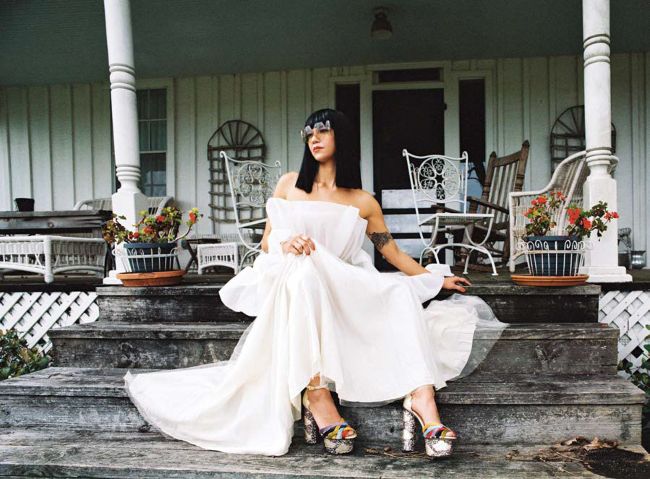
Porch songs: “We think in unison as a band,” says Lee
CARY FAGAN
Laura Lee "It’s live -100 per cent. We didn’t have material prepped before we went in”
There is more singing on
Mordechai
than on any other Khruangbin album. How did you approach writing lyrics?
Last year was the culmination of four years of touring, and I realised how much it had impacted my life. I never got sucked into the party, but I realised it was easy to get addicted to touring, the highs and lows. I needed to get back in touch with myself, the Laura Lee that exists outside of touring. So I wrote down as many stories as I could in the span of a week leading up to going into the studio. What I wrote wasn’t in a lyric format, they were stories specific to my experiences. Because we think in unison as a band, the lyrics have to make sense for each of us all to sing. So we used those stories as a starting point and created lyrics that are an extension of our history as an instrumental band, a sort of blank canvas for people to make up what the song is about. We wanted lyrics that were ambiguous and spacious enough that people can still write their own stories.
On this album, especially, voice often acts as a texture or as an instrument.
None of us are singers. We all sing, but we aren’t going to pretend that we can do vocal acrobatics. It’s usually all of us singing in unison, and it’s layered. We’ll sing it twice on top of itself. It’s imperfect. It creates a sort of psychedelic, dreamy texture, which is really important to the sound. The other thing is that we wrote lyrics after the music. It’s not like I wrote a song about my mum and then the music was written to ft that sentiment. It’s the opposite. It’s really important to us to sing words that sound good.
How do you decide which language you’re going to sing in?
I ended up writing “Pelota” in Spanish because it didn’t sound good in English. The main lyric of the song translates to “I want to be a ball”. It just doesn’t sound good. We have a song in French because, why not? One of the things we like about listening to music in other languages is that you’re less attached to the meaning. You’re more inclined to understand the meaning sonically. If I’m listening to a pop song from Turkey, I’m not actually thinking about what the singer is saying at all. We wanted to figure out a way to be able to do that, and putting the lyrics in different languages is one of them.
“Connaissais De Face” has a strong Serge Gainsbourg vibe. Was he the inspiration?
For this song and the whole album, really, we wanted to make sure that none of the songs were too directly referential to a particular country. That happened with our first two records. The first one, everyone kept talking about the Thai thing. And the second one was known as our Middle Eastern-inspired record, even though that wasn’t the only influence. The musical part of this song is really Ethiopian-sounding, so we wanted to find a way to twist it, so it didn’t sound too on-the-nose. So we added this conversational texture, a cinematic twist that made it sound French.
It was a cool thing that happened. I’m a huge fan of cinematic music, and I’m a huge Serge Gainsbourg fan. So if that’s what people hear, I’m flattered.
You mentioned that you wrote and recorded the music first. What was that process like?
It’s live - 100 per cent. We didn’t have material prepped before we went in, which is sort of terrifying, but it’s also just what we do. So we wrote a song and then after we learned it, we cut it live. We did as many takes as it took to get a near-perfect take. There was a sweet spot. And 80 per cent of the time it was on the third or fourth take. We wanted the right amount of nervousness and the right amount of confidence.
“It’s usually all of us singing in unison, and it’s layered. It creates a sort of dreamy texture”
That’s interesting, because the live show is such a key part of the
Khruangbin
experience.
We’re all sort of analogue in that way. It creates a limitation on what we can make, because we can’t sit there and recreate the perfect snare hit, for example. There’s a soul that happens when it’s live, and we just can’t fake it.
There are a lot of global touchstones on this record, but the American city of Houston is also really important to its sound. How do those two things go together?
Houston is one of the most diverse cities in America. The oil and gas and medical industries are so strong that people from all over the world come to work in Houston. That doesn’t necessarily mean that you can go out and hear a Pakistani band play, but you will have Pakistani friends whose parents will play that music while you’re at their house eating dinner. Based on what we look like, people ask us how we know each other. And for us it’s just like, “We’re from Houston. We look totally Houston.” We would have never been a band, and we would have never been inspired by what we’re inspired by, if it wasn’t for Houston. It’s a huge part of who we are.
INTERVIEW: ERIN OSMON
THE JAYHAWKS
XOXO SHAM/THRTYTIGERS
8/10
A new approach pays dividends for Americana’s great survivors.
By Andrew Mueller
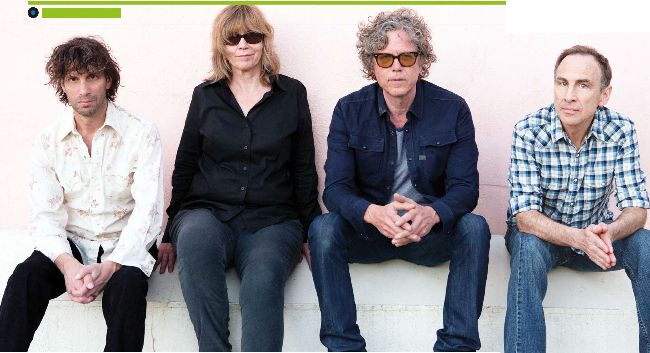
The Jayhawks (l-r); Marc Perlman, Karen Grotberg, Gary Louris, Tim O Reagan
IT is 35 years, give or take, since The Jayhawks formed in Minneapolis. It cannot have seemed, at the time, a likely long-term endeavour. In a city whose mid-’80s rock’n’roll soundtrack was being furnished by local punks like The Replacements, Hüsker Dü and Soul Asylum, the establishment of a country band dedicated to chiming choruses and soaring sunshiney harmonies was a spectacularly headlong windmill-tilt.
But all those years later, here The Jayhawks still are, and with an album that is certainly no worse than any of its 10 splendid predecessors, and that might age well enough to rank among their best. XOXO is the result of a recalibration of The Jayhawks’ internal dynamics: Gary Louris, The Jayhawks’ primary singer and songwriter, decided to open the floor to his colleagues. Though all have contributed to the writing before now, no previous Jayhawks album has been quite such a team ef ort in this respect. Only two tracks are credited solely to Louris. On six tracks, he isn’t credited at all. Lead vocal duties are shared.
This wasn’t ever likely to result in an upending of The Jayhawks’ aesthetic: bassist Marc Perlman has been with them since the start, and drummer Tim O’Reagan and keyboardist Karen Grotberg both date the beginnings of their service back to the mid-’90s. However responsibilities are divided, if these four people make a record, it’s going to to sound like a Jayhawks record. In terms of other Jayhawks records, then, XOXO probably has most in common with the big pop sound of 1997’s Sound Of Lies and the fretful country-rock of 2003’s Rainy Day Music: at the moments when that balance is most adroitly negotiated, XOXO sounds something like a classic.
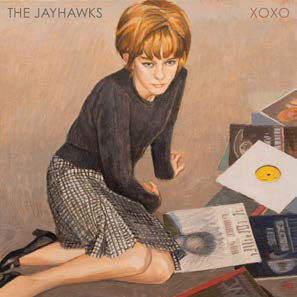
Opening track “This Forgotten Town” sounds, therefore, even more like a declaration of intent than it normally might. Lead vocals are swapped between Louris and O’Reagan, and the song itself sounds something like a cut-and-shut between The Jayhawks of Hollywood Town Hall (choogling Creedence Clearwater Revival country verses) and The Jayhawks of Sound Of Lies (ecstatic, harmony-drenched Gerry & The Pacemakers-variety choruses; it does not feel insignif cant that the cover image is Duncan Hannah’s “The British Invasion”, depicting a beehive-bouf anted 1960s pop fan contemplating her copy of The Zombies’ “Tell Her No”).
XOXO is sequenced a bit like a set by a nervous group preparing to play to an audience unfamiliar with them: The Jayhawks have massively frontloaded the irresistible tuneful bangers. O’Reagan’s “Dogtown Days” is a gleeful powerpop stomper, swaggering like Big Star and as hook-happy as Cheap Trick. Louris’s “Living In A Bubble”, following that, does have a point that it wishes to make - it’s a rumination on the information overload that is the default condition of 21st-century humanity - but it’s wedded to a jaunty honky-tonk piano backing that recalls one of Randy Newman’s sardonic country tunes, or even Gilbert O’Sullivan at his less vexingly twee.