THE TURBO OF 2-STROKES: PART II
General design criteria for a 2-stroke engine exhaust system
THE EXHAUST SYSTEM IN HIGH PERFORMANCE 2-STROKE ENGINES
BY PIERLUIGI MANCINI
From what has been previously stated, it is possible to understand how the exhaust apparatus scheme which, if appropriately optimized, best meets the needs of a fast 2-stroke engine provided with a divergent section and a convergent portion (in their actual manufacture, often each of these sections is subdivided into several parts characterized by different tapers, especially for the divergent section).
So far we have talked about optimization in terms of the timing of the depression and compression waves that return to the exhaust port. The objectives of this optimization are essentially two: 1) the depression must reach the discharge port when the piston begins to detect the transfer port, so as to favor the washing of the chamber by extracting the spent gases and facilitating their filling with the fresh charge; 2) the compression wave is required to reach the discharge port when the transfer port is closed and only the exhaust outlet is open, so as to limit the loss of fresh charge towards the muffler.
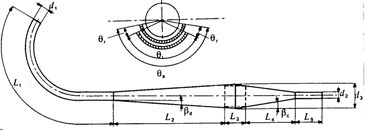
FIGURE III Typical geometrical parameters of a typical exhaust system formed by: an initial cylindrical section (exhaust manifold), a divergent section, a cylindrical central section (if any), a convergent section, and a final cylindrical section (“stinger or needle valve terminal”).
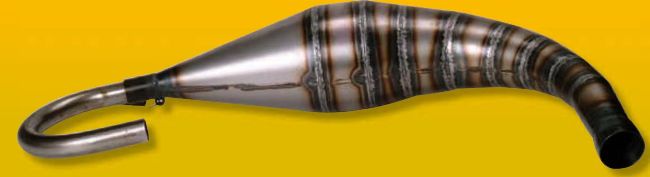
THE EXPANSION EXHAUST ALLOWS TO DRASTICALLY IMPROVE THE VOLUMETRIC EFFICIENCY OF THE 2-STROKE. THE INVENTION OF THE INGENIOUS WALTER KAADEN ALLOWED THE 2-STROKE ENGINES TO OVERTAKE, WITH THE SAME DISPLACEMENT, THE 4-STROKE THAT DOMINATED THE SCENES
Although there are many calculation software programs available today that allow to simulate an engine's operation, it is still useful to start from a general geometric measure based on semi-empirical calculation processes, supported by experimental tests. The criterion that is described below is aimed at determining the geometry of a muffler scheme such as in figure iii; it is composed of an initial cylindrical section (exhaust manifold), a divergent section, possibly a central cylindrical section or "belly", a convergent section and a final cylindrical section or "stinger". With regard to the length l1 of the initial cylindrical section, it can be seen that, in order to have a good effect of extracting the gas exploded from the cylinder, it is necessary that the rarefaction wave reflected from its open section, and progressively from the divergent l2, arrives in the exhaust port when the transfer port begins to be uncovered. It follows that l1 must be such as to delay the depression wave after qr (angle of delay in the opening of the washing ports with respect to the exhaust ports) degrees of rotation of the driving shaft.