EVERY SUV RATED
With so many SUVs to choose from, it’s hard to know where to start. Follow our guide, though, and you’ll know the champions from the chumps
Family SUVs
FIRST DRIVE
Honda ZR-V
All-new hybrid family SUV aims to combine low running costs with sharp handling On sale October Price from £39,495
IF YOU’RE EVER unsure what size of coffee to order in Starbucks, Honda’s line-up will have you equally baffled when picking an SUV. Let’s clear things up, then: this new ZR-V is like a Grande Cappuccino. It’s a medium-sized serving that slips between the Tall HR-V and the Venti CR-V on Honda’s SUV menu.
Fortunately, things get a lot simpler when it comes to choosing which ZR-V to buy. All versions come with the same 2.0-litre petrol hybrid set-up (named e:HEV) as the Civic hatchback, producing a healthy 181bhp. The 0-62mph sprint takes around 8.0sec, matching the figures for the more powerful Hyundai Tucson and Kia Sportage hybrids.
Because the hybrid system has no physical gears, progress is smoother than in those rivals, too. The ZR-V is hushed at low speeds, when it’s often the electric motor alone pulling you along. The relatively small battery means it can only do that for short spells, but electric assistance lasts longer and is more frequent than in most other hybrid rivals – although not the Renault Austral.
The ZR-V isn’t as quiet as a Sportage at motorway speeds; there’s more noise from the tyres and as the wind rushes past the windscreen. There’s a bit of suspension noise as it deals with lowspeed bumps, too, but it’s no louder than it is in most rivals.
The ride is a little on the firm side, but the trade-off is that the ZR-V resists body lean well in corners, and it feels pleasingly agile. The steering doesn’t feel as meaty as that of the Sportage, but it’s precise enough. There’s lots of grip, too, allowing you to flow down a country road with confidence.
The driving position is lower than in most SUVs; that’s a deliberate decision by Honda to make the ZR-V feel more like the Civic inside. The two cars have very similar dashboards, too, and that’s no bad thing; it means the ZR-V’s is attractive, very well made and easy to use, with physical air-con controls that are far less distracting to operate when driving than the touch-sensitive pads of the Volkswagen Tiguan.
All ZR-Vs come with a 9.0in infotainment touchscreen with built-in sat-nav, plus wired Android Auto and wireless Apple CarPlay smartphone mirroring. The screen is fairly clear and responsive to inputs, and the relatively simple menu layout has plenty of shortcuts, enabling you to hop directly between functions.
In terms of interior space, the ZR-V can’t challenge the Tucson and Sportage, but few will find it cramped. There’s plenty of leg and head room for six-footers in the front, and while the ZR-V isn’t the most commodious when it comes to rear seat space, a pair of similarly tall passengers will still be able to fit comfortably.
While the ZR-V’s boot is large enough for a weekly shop or several carry-on suitcases, its capacity of less than 400 litres is a bit disappointing, pipped even by that of the smaller Audi Q2.
The cheapest ZR-V, in Elegance trim, starts at £39,495, and that makes it considerably pricier than the Tucson and Sportage hybrids in their equivalent trim levels. In terms of running costs, the ZR-V’s official fuel economy of 49.6mpg is on a par with that of hybrid rivals and compares well with a lot of thirstier petrol rivals.
The ZR-V’s CO2emissions of around 130g/km are competitive (if worse than the Austral’s 105-110g/km figures), but company car drivers will be much better served by a plug-in hybrid; their lower official emissions result in smaller benefit-in-kind tax bills.
If you’re deciding between this and the Civic, though, the ZR-V offers a bit more rear head room and is slightly quieter (with less engine and road noise). However, while it balances enjoyable handling with strong economy, its higher price is difficult to justify when its rivals are more practical.
Our pick 2.0 e:HEV Elegance List price £39,495 Target Price na Target PCP na MPG 49.6 CO2 130g/km For Smart, easy-to-use interior; strong fuel economy; enjoyable to drive Against Pricey against rivals; small boot; could be quieter WHAT CAR? SAYS ★★★
FIRST DRIVE
Renault Austral
Exclusively hybrid replacement for the Kadjar focuses on fuel efficiency On sale Now Price from £34,695
THIS REPLACEMENT FOR the popular Kadjar family SUV ditches traditional petrol engines in favour of a hybrid one. And, being armed with a 2.0kWh battery (bigger, for example, than the 1.49kWh units of the Hyundai Tucson and Kia Sportage), the Austral has the legs over most rivals when it comes to how far it can go on electric power alone.
As a result, the Austral uses petrol sparingly; among hybrid rivals, only the slightly smaller Kia Niro pips its official average of 60.1mpg. Strong predicted resale values will help to keep running costs down, too. However, the set-up can be jerky in the way it delivers its power.
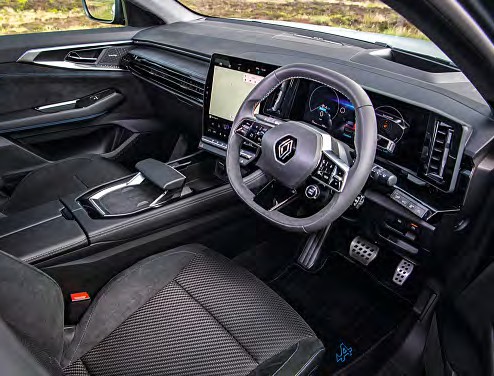
Austral is fresh and distinctive inside, but most of its rivals beat it for quality and finish
So far, we’ve tried only the top Iconic Esprit Alpine trim, which brings fourwheel steering to boost agility, but don’t expect a sporty driving experience. This set-up does, though, give the Austral an impressively small turning circle, so it’s a cinch to manoeuvre around town.
On the 20in wheels of our test car, the Austral’s firm ride feels unsettled at most speeds, and both road and wind noise could be better suppressed.
Inside, the Austral looks pleasingly modern and is packed with equipment. There isn’t as much interior space as in the Sportage and Tucson, nor as much boot space, but the Austral’s handy sliding rear seats help you juggle leg room and luggage capacity as it suits.