SET UP TO FAIL?
In its initial guise, the Trident was a world beater set to steal Boeing’s thunder and rob the US manufacturer of 727 sales. Sent back to the drawing board by British European Airways, the world’s first trijet airliner was deprived of performance and passengers making it a financial flop. Stephen Skinner details its development and early variants in the first of two instalments
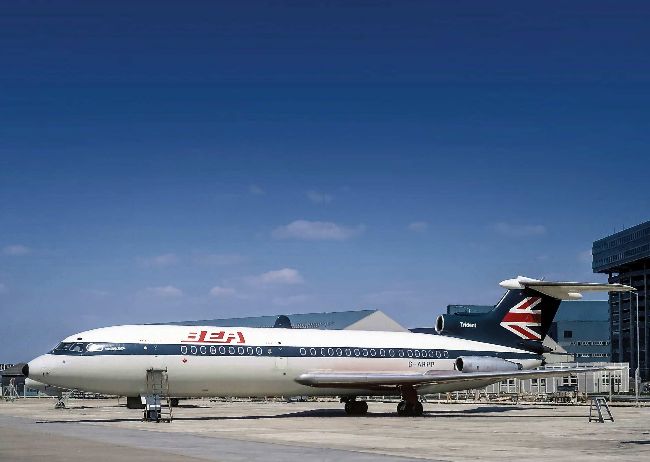
BEA Trident 1E, G-ARPP (c/n 2117), at the company's Heathrow maintenance base in the later Speedjack livery
AIRTEAMIMAGES.COM/ ATI COLLECTION
In April 1956 British European Airways (BEA) had no need for jet aircraft, indeed its chief executive, Anthony Milward said he would “rather do without”. Desperate to keep up with the Joneses and their new jets, but not knowing which way to turn, within three months the company had ordered the larger Vickers Vanguard to supplement its Viscounts. However, Milward was quickly forced to eat his words and, knowing a Sud Aviation Caravelle order wouldn’t receive government approval, issued requirements to British aircraft manufacturers for a second-generation short-haul jet.
Six firms bid for the project – with offerings including the Bristol Type 200 and Avro’s 740, a futuristic V-tailed trijet – but BEA chose the de Havilland DH.121 which was planned as a 110-seater and, with its three Rolls-Royce RB141 Medways of 13,500lb st each, had range of up to 2,000 miles.
With the design’s specifications seemingly set in stone, indecision set in once again and BEA stated its passenger forecasts were over optimistic and demanded a substantial downsizing. The carrier’s new airliner required approximately 40% less thrust, half the range and 20% less passenger capacity of the original DH.121.
Knowing BEA was then the only customer and certain to place a large order, the manufacturer’s management offered little resistance to this drastic change in specification. However, this arrangement crippled the aircraft’s sales potential, enabling the larger and superior performing Boeing 727 to steal a march on the Hatfield-developed airliner and eventually accrue 15 times the number of orders mustered by the de Havilland-designed type.