SPAE WARS
IS PLANET EARTH READY FOR A COSMIC BATTLEGROUND?
SEVERAL COUNTRIES ARE SPENDING A LOT MORE ON MILITARY SPACE, WORRYING PEACEMAKERS
Reported by Ian Parker

© Tobias Roetsch
Years ago, Buzz Aldrin said: “Once you have stood on another celestial body and looked back at the Earth, you realise how small, precious and fragile it is amid the vastness of space.
We shouldn’t be fighting over it.” Buzz was a successful fighter pilot before he became an astronaut, and the experience of walking on the Moon changed him hugely. The moonwalkers went there in peace for all humankind. If NASA plans work out, they will do it again.
Most have always had philosophies and feelings which transcend national, cultural and racial barriers. It comes with the turf. Space agencies around the world, including NASA and the European Space Agency (ESA), are for the peaceful exploration of space. But for others, ‘peaceful’ equates with ‘defence’, since strong armed forces can keep the peace. Military planners in the richer nations are increasingly turning their attention to space for the protection of space assets and services and possible warfighting in orbit. Developments in civil space can often be applied to military programs.
Recent, very worrying political events have shown that even the most developed and trusted political systems are failing to prevent megalomaniacs from gaining power. And these people are often in charge of the armed forces. If the bad are strong, then the good must be stronger. But this can often lead to the proliferation of arms and a strengthening of the military-industrial machine where manufacturers make a huge amount of money out of arms contracts, therefore influencing politicians to support military spending. At one point the US had some 31,000 nuclear warheads, and you might wonder how many planets they were planning to destroy with those.
As far as we know, no country has ever put a nuclear warhead in space, as it was banned by international agreement decades ago – it probably isn’t that advantageous anyway. It may seem strategic to put them in geostationary orbit, 36,000 kilometres (22,370 miles) above a likely enemy, but it’s better to keep them on rockets in underground silos because they need servicing.
Even if an intercontinental ballistic missile (ICBM) has to fly halfway around the world to attack an enemy, it’s still a shorter distance than flying down from geostationary orbit.
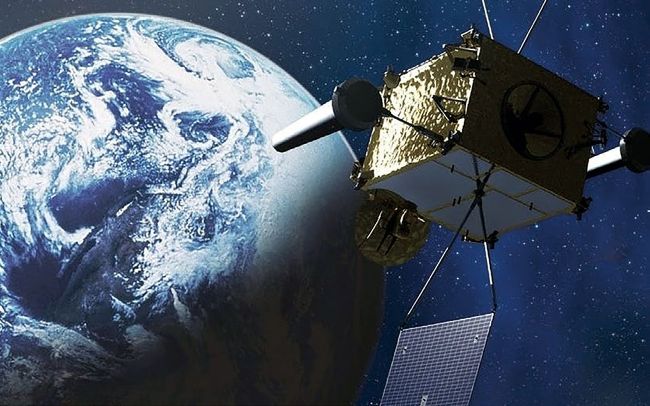
Skynet 6 is the UK’s next military communications satellite
© SATCOM
Destroying a satellite with a bomb or even just an impact has been demonstrated, but it’s very expensive – and it might miss. A large number of conventional missiles simply miss their targets, even if the target isn’t being evasive. It’s far better to attack satellites by uploading debilitating data or with lasers, both from the ground or other spacecraft. Alternatively, the services they provide can be attacked. For example, the GPS signal at ground level is quite weak, and it doesn’t take much to scramble or spoof it. It can’t be easily strengthened because of the altitude of the satellites and their limited solar panels.