ASTROPHYSICS
How do black holes form?
ASK space
Our experts answer your questions
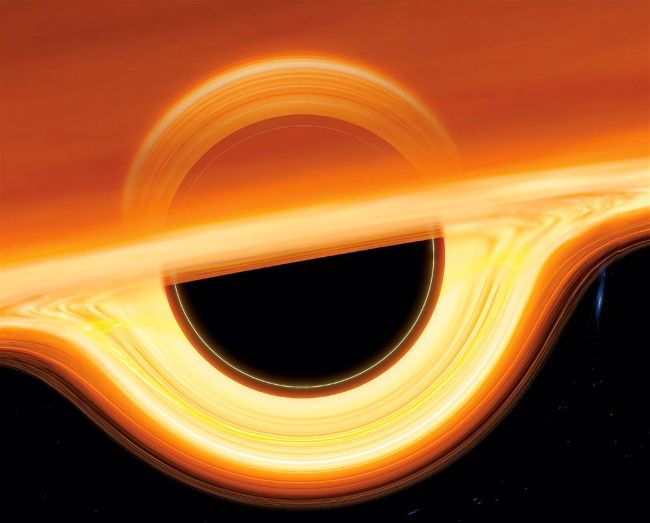
There are different types of black holes in the universe
© Getty
Most black holes form when a massive star exhausts its fuel supply and collapses. But the origins of the largest black holes remain mysterious. There are two very different types of black holes in the universe: stellar-mass black holes and supermassive black holes. Stellarmass black holes are much more common, and usually weigh in at about 5 to 100 times the mass of the Sun. These form when a massive star fuses all of the material in its core into iron and can no longer provide additional energy to support its immense weight against gravity. The star then begins to collapse. Sometimes this triggers a supernova explosion that destroys the star, but if this explosion fails the collapse continues until the star is crushed down into a black hole.
Supermassive black holes are enormous: millions to billions of times the mass of the Sun. There’s one in every large galaxy, right at the centre. We don’t yet know how they got there. They may have formed directly from the collapse of huge gas clouds, or started as stellar-mass black holes that grew by swallowing material. Figuring out their origins is a major area of current research and one of the motivations for launching the James Webb Space Telescope.
Dr Daniel Perley, Astrophysics Research Institute, Liverpool John Moores University

Planes can’t fly in space as there’s no oxygen
© Getty