25 UNBELIVABLE FACTS ABOUT
THE SOLAR SYSTEM
Reported by Elizabeth Howell, Vicky Stein and Daisy Dobrijevic
© Tobias Roetsch
1 The Solar System is really big The Sun’s
NASA's Voyager 1 spacecraft was launched in 19 77. More than three decades later, in 2012 it b ecame the first human-made object to enter in terstellar space by crossing the heliopause – th e edge of the heliosphere. That's the boundary b eyond which most of the Sun's ejected particles a nd magnetic fields dissipate. “If we define our Solar System as the Sun and everything that p rimarily orbits the Sun, Voyager 1 will remain w ithin the confines of the Solar System until it em erges from the Oort Cloud in another 14,000 to 28,000 years,” NASA says.
“The Moon is both mind-bogglingly distant and incredibly close depending on how you think about it”
2 Even just our neighbourhood is really big
Depending on how carefully you do the calculations and how you arrange them, all of the planets in the Solar System could fit in between Earth and its Moon. The distance between Earth and the Moon varies as it orbits around us, as does the diameter of each of the planets – they’re wider at their equators, so Saturn and Jupiter would have to be tilted sideways for this to work. But imagine lining them all up, pole to pole. They’d just barely squeeze in between us and our closest companion in space, blocking out the sky with their rings and gas giant bulk as they did so.
The Moon is the farthest from Earth we’ve ever sent humans, and it’s both mind-bogglingly distant and incredibly close depending on how you think about it. Eight enormous planets could fit between here and there, and the distance from Earth to the Sun is more than 390 times the distance from Earth to the Moon. Scientists use an approximation of the Earth-Sun distance, also known as one astronomical unit, or AU, to compare distances within the Solar System. Jupiter is about 5.2 AU from the Sun, and Neptune is 30.07 AU from the Sun – around 30 times as far from the star as Earth.
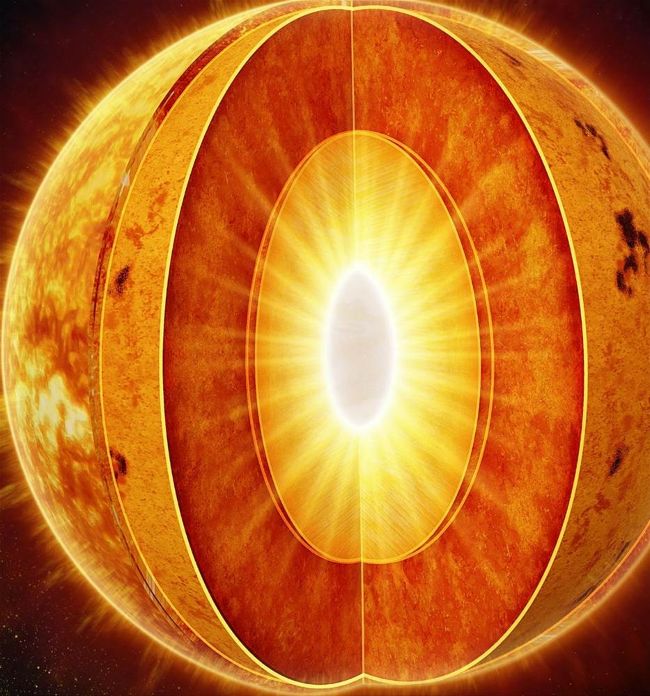
3 atmosphere is hotter than its surface
While the Sun’s visible surface, the photosphere, is 5,500 degrees Celsius (10,000 degrees Fahrenheit), its upper atmosphere has temperatures in the millions of degrees. It’s a large temperature differential with little explanation. NASA has several Sun-gazing spacecraft on the case, however, and they have some ideas for how the heat is generated. One is ‘heat bombs’, which happen when magnetic fields cross and realign in the corona. Another is when plasma waves move from the Sun’s surface into the corona. With new data from the Parker Solar Probe – which recently became the first human-made object to ‘touch’ the Sun – coming in all the time, we’re closer than ever to unlocking the mysteries at the heart of our Solar System.
© Tobias Roetsch
4 Mercury is still shrinking
Mercury is already the smallest planet in the Solar System, and is the second-densest after Earth. And it’s only getting smaller and denser. For many years, scientists believed that Earth was the only tectonically active planet in the Solar System. But that changed after the Mercury Surface, Space Environment, Geochemistry and Ranging (MESSENGER) spacecraft did the first orbital mission at Mercury, mapping the entire planet in high definition and getting a look at the features on its cratered surface.