TIME IS IT AN IILUSION?
TIME IS ONE OF THE MOST PUZZLING PHENOMENA IN THE UNIVERSE. HERE WE TAKE A LOOK AT THE LATEST IDEAS ABOUT ITS NATURE AND ORIGINS
Reported by Giles Sparrow
Time’s endless flow shapes the way we understand the world. Being carried along on a river of time T that only flows in one direction is essential to our understanding of the universe. But what exactly is time, and where does it come from? Recent research is suggesting some surprising new ideas. For more than a century, scientists have treated time as a dimension – a ‘direction of travel’ both similar to and radically different from the three space dimensions. Thanks to Einstein’s theory of general relativity, it’s also clear that space and time are wrapped up together in a complex ‘continuum’ called space-time. In extreme situations, distance in space and the flow of time can be stretched, compressed or even exchanged.
Professor Sean Carroll, author of From Eternity to Here: The Quest for the Ultimate Theory of Time, argues that time isn’t really that hard to understand. “I don’t think it’s a mystery, and I don’t think it’s been a mystery for a very long time,” he explains. “It was a bit simpler back when we had Isaac Newton and time and space were both absolute. Then we would have considered the universe to be made of space and everything in it, and the universe keeps happening over and over again – time is just the label we put on those different versions that happen one after another with things in different positions, a bit like the pages of a book.

Physicists are using the principles of holograms to try to understand how time works
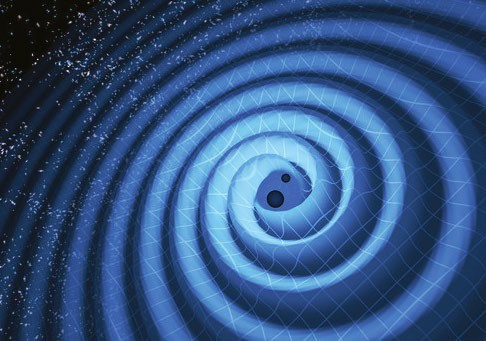
Collisions between black holes produce gravitational waves – these ripples may reveal ‘new’ time being created
© Getty; LIGO
“In Einstein’s view there’s actually ‘space-time’, and how an observer slices that space-time into time and space is a little arbitrary,” continues Carroll, the Homewood professor of natural philosophy at Johns Hopkins University. “Different people can look at it in different ways, and no one is right and no one is wrong. But still, in any one point of view there’s a sequence of moments. It’s a little more complicated, but really it’s not that hard – it’s certainly no more profound to ask what time is than to ask than what space is.”
The effects described by Einstein arise in part because the universe has an ultimate speed limit – the speed of light itself. This means your experience of the present incorporates light and other information that began its journey from distant objects as they were in the past. What’s more, everyone’s experience of a single moment in time will be different depending on their position and motion in space. The limited speed of light also helps to define cause and effect – a key aspect of our understanding of the universe in which earlier events can shape later ones, but not the other way around. Because one object or event can only influence another if an signal of some kind passes between them, there are limits to the region of past space capable of influencing a particular point in the present. Physicists often depict this idea in terms of a ‘light cone’, with a single point in present-day space at the tip and an expanding cone reaching back into the past, encompassing regions of spacetime capable of influencing that point in the present. There may be plenty more of the universe outside of that light cone, but those regions are forever out of sight and incapable of influence.