GB
  
You are currently viewing the United Kingdom version of the site.
Would you like to switch to your local site?
16 MIN READ TIME

Feature

HUNTING FOR INTERSTELLAR PLANETS

Space is suspected to be filled with worlds wandering alone without a star, but could such loners ever shelter life?

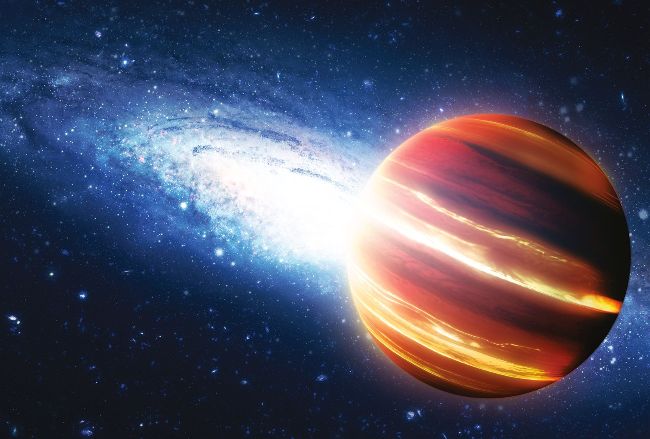
Rogue planet
© NASA

In the past few decades, we’ve grown used to the idea of exoplanets – distant worlds orbiting stars in alien solar systems. Some I of these planets are very different from our own – scorched gas giants skimming the surfaces of their stars or frozen balls of ice larger than Earth. But perhaps the strangest exoplanets are those that drift alone through the darkness of interstellar space, far from the heat and light of any star. Only a handful of these objects are known, but many billions of them could be scattered across our galaxy – estimates vary from at least a couple for each of the Milky Way’s 200-billionplus stars, up to an astonishing 100,000.

Astronomers call these mysterious worlds interstellar or ‘rogue’ planets, but in order to understand them, we first need to find them and learn more about their characteristics – and that’s a challenge in itself. The vast majority of exoplanets discovered so far have been detected through their influence on their parent stars – either the tug of their gravity on the star’s path through space or slight dips in the star’s brightness as a planet transits in front of its star as seen from Earth. But for interstellar planets, neither of these techniques work. The other obvious route of observing them through their own light and other radiation is also caught in a catch-22 situation: while the light of exoplanets is often drowned by that of the stars they orbit, most are only visible at all thanks to reflected starlight. Earth-like interstellar planets – relatively tiny balls of rock floating far from any stars – are so small, cold and faint as to be almost impossible to detect. The only exception might be if they wander by chance in front of a more distant star and create a microlensing event, where the starlight is bent.

Fortunately, there are occasional lone planets, still hot from the gravitational collapse in which they formed, that give out light of their own, shining dimly but distinctly if viewed through powerful telescopes and emitting radiation that can reveal important clues to their other properties. One intriguing example, catalogued as PSO J318.5-22, was discovered in 2013 by a team including Dr Niall Deacon, now at the Max Planck Institute for Astronomy. Deacon specialises in studying wide-orbit planets. But it was during a search for brown dwarfs that he and his colleagues stumbled across the object he calls PSO J318.

“We were doing a large survey with the Pan-STARRS [Panoramic Survey Telescope and Rapid Response System] observatory on Maui, Hawaii. We looked for very red objects that drift across the sky a bit – lots of distant galaxies are red, but if an object is moving quickly across the sky, it must be nearby. We detected a bunch of candidates and did follow-up measurements with the United Kingdom InfraRed Telescope on Mauna Kea, and Mike Liu noticed that this object was really, really red. We followed it up with a spectrum from NASA’s Infrared Telescope Facility and found that its light was very similar to that of the planets around HR 8799. Based on its colours and spectrum, we knew that it might be a free-floating planet.”

Unlock this article and much more with
You can enjoy:
Enjoy this edition in full
Instant access to 600+ titles
Thousands of back issues
No contract or commitment
Try for 99p
SUBSCRIBE NOW
30 day trial, then just £9.99 / month. Cancel anytime. New subscribers only.


Learn more
Pocketmags Plus
Pocketmags Plus

This article is from...


View Issues
All About Space
Issue 144
VIEW IN STORE

Other Articles in this Issue


WELCOME
WELCOME
ISSUE 144 SCAN HERE TO GET OUR DAILY
LAUNCHPAD
Wreckage of a titanic cosmic explosion
A new image from the James Webb Space
Ultra Deep Field
© NASA NASA’s James Webb Space Telescope has
Mars’ mysterious moon Deimos
© Emirates Mars Mission A moon of Mars
Saturn reclaims ‘moon king’ title with 62 new found satellites
KEEP IN TOUCH /AllAboutSpaceMagazine @spaceanswers space@spaceanswers.com Astronomers have
James Webb Space Telescope catches ancient galaxy in the act of explosive star birth
An illustration of the James Webb Space Telescope
Two ‘super-Earth’ exoplanets spotted in habitable zone of nearby star
An illustration of two super-Earths orbiting the same
Ambitious asteroid mission will tour seven space rocks
The United Arab Emirates (UAE) is targeting seven
SECRETS OF OBJECTX
Within the confines of the Triangulum Galaxy lies a mysterious object, but have scientists finally worked out why it behaves so strangely?
LARGE BINOCULAR TELESCOPE (LBT)
1 First observation The first image from the
FOCUS ON
PENTAGON HAS “NO CREDIBLE EVIDENCE” OF ALIENS OR UFOS
The new UFO office has no proof of any extraterrestrial or extraordinary objects
SIGNS OF RECENT WATER ACTIVITY FOUND ON RED PLANET
Martian water played a major role in creating intriguing surface features on miniature sand dunes
WHAT’S NEXT FOR VIRGIN ORBIT?
The company set up by Sir Richard Branson to send satellites into orbit from a plane is facing an uncertain future, and that could have repercussions for the UK’s space ambitions
DISCOVERED: CLOSEST STAR-SHREDDING BLACK HOLE TO EARTH EVER SEEN
It was found by astronomers comparing maps of the universe
WHERE DID EARTH GET ITS WATER FROM?
Two new scientific studies have sailed researchers ever closer to discovering the source of Earth's water
URANUS’ MOONS MAY HAVE OCEANS OF SALTY WATER
If the moons had benefited from long-term heating, then they could have maintained a thick ocean
What do we know about the surface of super-Earth Kepler-452b?
We know very little about what the planet
What sort of measures can we take to protect against asteroid impacts?
What’s important is finding the larger asteroids before
What would you say is the biggest scientific space breakthrough?
When we see something like Curiosity on Mars,
What’s involved in training to become an astronaut?
As an astronaut, you get trained to do
What was it like to witness the end of the Space Race between the US and USSR in 1975?
The US worked with Russia on the Apollo-Soyuz
How did life form on Earth?
A lot of big discoveries have been made
Why do some telescopes operate in radio wavelengths?
Live formed on Earth after the planet began
FUTURE TECH
PLUTO ORBITER AND LANDER
US aerospace consultancy Princeton Satellite Systems is working with NASA on an engine that could open up the Solar System
INTERVIEW
“Technology has really won the argument”
Comedian, actor and lover of all things science, Ben Miller has documented the search for alien life in a new book with optimism for the future. Are we really alone in the universe?
INSTANT EXPERT
HOW ARE AURORAE FORMED ON OTHER PLANETS?
The northern and southern lights occur when the solar wind affects our atmosphere, but this can happen on other worlds too
THE FACE ON MARS AND OTHER SHAPES IN SPACE
Humans keep finding patterns among the stars, helping us locate and recognise astronomical wonders
IFOCUS ON
MOONQUAKES COULD ‘SMOOTH OUT’ THE SURFACES OF JUPITER AND SATURN’S ICY MOONS
Tectonic activity triggered by the gravitational influence of the gas giants causes landslides of debris
SECRET LIVES OF SPACE’S GREATEST HEROES
These six men and women made groundbreaking contributions to our understanding of the universe, and their stories are often linked in surprising ways
STARGAZER
WHAT’S IN THE SKY?
What to look out for during this observing period
PLANETARUIM
THIS MONTH’S PLANETS
Venus takes part in a striking conjunction this
LANGRENUS CRATER
This month, we help you find one of the Moon’s best hidden gems
NAKED EYE AND BINOCULAR TARGETS
The constellations of Hercules, Scorpius and Corona Borealis are ideal targets for those using binoculars or the unaided eye
NEBULAE AND CLUSTERS OF THE SUMMER
The nights are still short, but there are plenty of things to see if you’re a night owl
NORTHERN HEMISPHERE
A gaggle of galaxies, star clusters and nebulae grace the July skies
OLYMPUS 8X25 WP II
For casual skywatchers, the portable Olympus 8x25 WP II boasts an excellent optical system for views of the Moon and bright targets with superb contrast
IN THE SHOPS: BOOKS
Choose the reading material you’ll want to peruse on the beach or by the swimming pool
JEREMY HANSEN
The first non-American to leave low Earth orbit on Moon mission Artemis 2
ALL ABOUT SPACE
Future PLC Quay House, The Ambury, Bath, BA1
Chat
X
Pocketmags Support