THE FACE ON MARS AND OTHER SHAPES IN SPACE
Humans keep finding patterns among the stars, helping us locate and recognise astronomical wonders
Written by Nikole Robinson
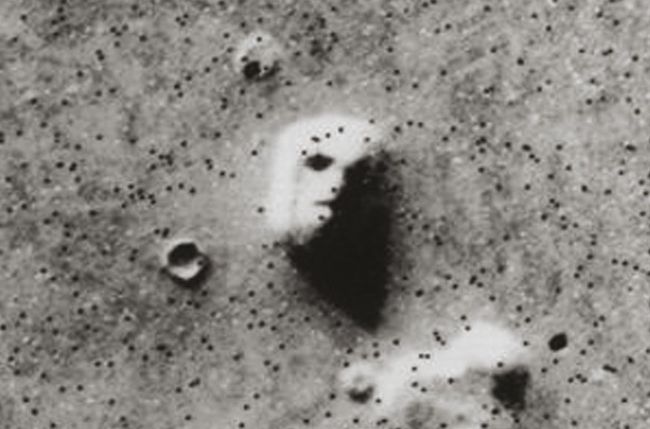
MARTIAN MASK
25 July 1976
When NASA scientists were inspecting photos beamed back by Viking 1 and 2 in the 1970s, the last thing they expected to see was a stony face staring back at them. This twokilometre (1.2-mile) wide feature watched its observers from a region of Mars called Cydonia. Taking into account the low camera quality available in the 1970s, the face was quickly dismissed as a trick of the light by Viking project scientist Gerry Soffen and his colleagues. More recent visits by advanced spacecraft like the Mars Reconnaissance Orbiter have confirmed the mask-like structure to be a mesa, a flat-topped area of elevation which is common in the Cydonia region of Mars.
Since the first ancient humans turned their gaze to the skies above, civilisations began familiarising themselves with the inky blackness of the night sky using the patterns they saw in it – much like a join-the-dots puzzle of the points of light we now know to be stars, nebulae and galaxies. These patterns resembled recognisable objects or animals within different cultures and were used to track the seasons and for navigation. Modern astronomy uses a very similar system, with 88 official constellations used to divide the sky into sections, many based on those used by past cultures and explorers.
Looking further into the cosmos with everimproving telescope technology has shown that there are shapes and patterns to be found beyond the constellations as well, with wispy filaments of gas and dust, clusters of stars and even the surfaces of planets surprising us with something familiar so far from home.