BATTLE OF CAPORETTO
Greatest Battles
Written by Nick Soldinger
NORTHEAST ITALY/WESTERN SLOVENIA, 24 OCT – 10 NOV 1917
At 2am on 24 October 1917, Austro-German forces unleashed a devastating artillery attack against Italian troops defending land they’d captured in a long series of brutal and costly offensives. It was the opening salvo in a battle that would lead to one of the greatest military catastrophes of World War I.
After two and a half years of a vicious war fought in a dramatic, often frozen landscape thousands of feet up in the clouds, the Italian defences were well built. Earthworks and underground bunkers had been dynamited and drilled into the region’s mountainous terrain, while an elaborate trench system stretched across the valley floors below. Although these had proven resilient in the face of previous artillery attacks, they did little to protect the Italian troops from the horror that now rained
down upon them. Approximately 10 per cent of the shells fired that morning contained phosgene gas. Although the use of chemical weapons was commonplace on the Western Front, poison gas had never been used before in the so-called White War that raged in the Alps. The Italian high command had completely underestimated the power of this new terror weapon and its troops were ill-equipped to deal with it. The results were devastating.
At 8am, the Austro-German infantry assault began. As it advanced in a pincer movement to seize the river crossing at Caporetto, it encountered little resistance from what had been a numerically superior force. The gas attack had been so effective that hundreds of Italian troops now lay dead in their defences without having fired a shot. Thousands more, meanwhile, were fleeing the battlefield and heading west. What unfolded next would have disastrous consequences for Italy, creating social and political upheaval for years to come. And, although Italy’s troops would be accused of cowardice, responsibility for the disaster was largely due to the shortcomings of one man.
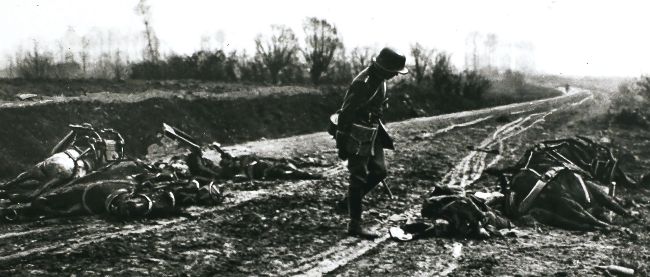
A soldier surveys the bloody aftermath of fighting along a road in the Julian Alps
Main image: © Getty Images
THE WHITE WAR
By the time World War I broke out on 28 July 1914, Italy’s chief of staff General Luigi Cadorna was a career staff officer on the brink of retirement. A strict disciplinarian from an aristocratic background, he was privileged and autocratic, with a reputation for arrogance and a history of mistreating his men.
Italy had been part of the Triple Alliance, a defensive pact it had formed with Imperial Germany and the Austro-Hungarian Empire in 1882. Rather than side with its allies at the outbreak of war, however, the country’s political leadership kept Italy out of the conflict until they’d weighed up the odds.