Complete guide to solar water heating
Daylight is fairly constant and predictable, even in the UK – so it’s no surprise solar hot water panels are among the most reliable renewable technologies available to self builders and renovators. These arrays collect energy from the sun and repurpose it to warm water for everyday washing and bathing. They’re rarely used to contribute to space heating – partly because the Renewable Heat Incentive (RHI) cashback scheme only pays out if the energy is put into domestic hot water (DHW).
Much of the work in heating water is needed to take it from cold to a lukewarm temperature – so even on dull days, a solar thermal array can be of benefit. Well-designed and operated systems can provide 50% of the energy required to meet a household’s annual DHW demand (depending on location). This is known as the solar fraction.
Another source (usually a fossil fuel boiler) will be required during winter in order to act as a backup across the rest of the year.
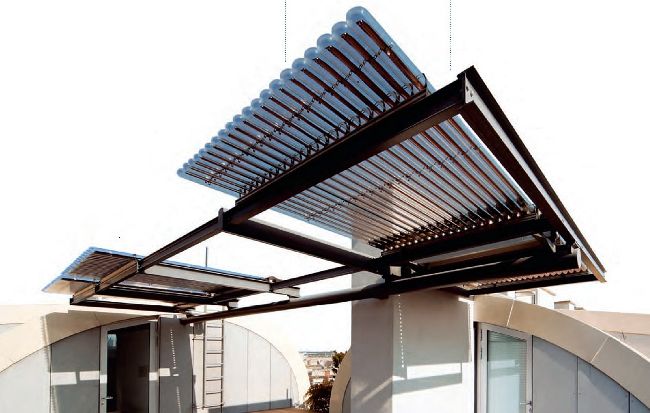
On this project, Vitosol 200-T vacuum tube panels from Viessmann have been used as an architectural feature
Harnessing free energy from the sun could cut your heating bills in half, says Nigel Griffiths, but is it the right system for you?
How solar thermal works
The vast majority of these systems heat water indirectly. The liquid that circulates through the solar collectors is contained in a sealed loop and the heat is then transferred to a storage cylinder by means of an exchanger coil. Mains water enters the cylinder at the base, where it’s warmed by the solar-linked exchanger and a second coil, which runs off the boiler (or another appliance). The heated water exits at the top of the vessel to feed baths, showers and taps.
As it has two sources of energy, the storage vessel is known as a twincoil cylinder. Heat rises, so the base of the tank is normally cooler than the top. The solar coil is therefore located near the bottom of the cylinder, where it’s coolest, to make the best use of whatever resource is available from the thermal panels. An electric immersion backup is often fitted, but this shouldn’t be needed if the controls are set effectively.