MASTERING THE DALEK PLANS
For many readers of 1973’s Doctor Who Radio Times special, the highlight of the souvenir magazine was a set of instructions showing how to build a full-size Dalek.
By JAMIE LENMAN
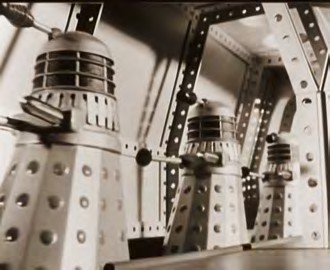
The production-line sequence from The Power of the Daleks (1966).
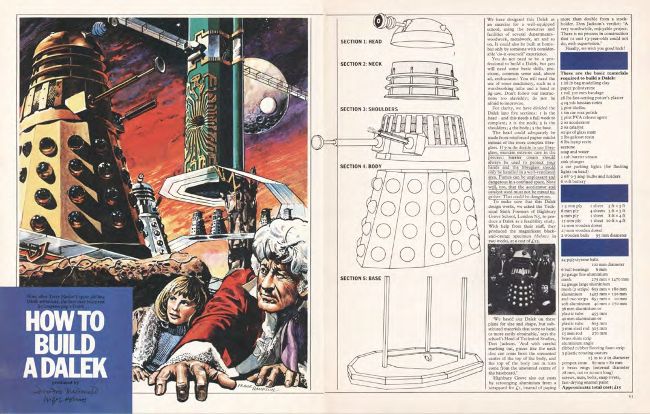
The first spread of instructions on How to Build a Dalek from the Radio Times Doctor Who special.
I’ve loved Doctor Who as long as I can remember,” says Stuart Quinn-Harvey of Manchester. “One of my first memories is seeing the Dalek production line in [1966’s] The Power of the Daleks. It just always seems to have been in my consciousness…”
Perhaps this striking scene of an alien assembly line was responsible for sparking a particular fire in Stuart’s mind, and the minds of so many other children of his generation – the insatiable desire to construct their own Dalek. As the series celebrated its tenth birthday,
scores of budding monster-makers were at last granted the crucial information that made this possible, when a set of comprehensive plans was included in the Radio Times’
magnificent 1973 Doctor Who special. “I was born in 1964 and didn’t actually get to see a copy of the tenth anniversary special until 1975 – Itried every newsagent I could find,” remembers Stuart. “It wasn’t until I was living in Harrogate that I saw it: a friend had it. Immediately I suggested that we build a Dalek together. The plans looked easy enough.”
Indeed, this is the genius of the document. Detailed in crisp black radiograph pen and friendly blue text, those five pages of Nigel Holmes’ drawings and Deirdre MacDonald’s instructions made a task previously achievable only by atomically mutated cyborgs from the future seem simple enough for school kids. “Deirdre and I worked closely together, fitting her text to my diagrams,” says Holmes, now 80 and still working as a graphic designer. “For every job, I sketch first – very rough and scribbly, but, most importantly, full size – to plan out where text and drawings can go. Then I do the actual drawings (on separate pieces of paper, so they can be moved around) and paste up the whole thing onto boards, exactly as you see them printed.”