DEMONSTRATING THE VALUE OF DIGGING DEEPER
MANY NAMES, ONE MAN
What began as a routine search to ‘kill off’ a distant cousin ended with an ‘Irish’ divorce and bigamy for professional genealogist Claire Bradley. Here she recounts her research journey.
Claire Bradley
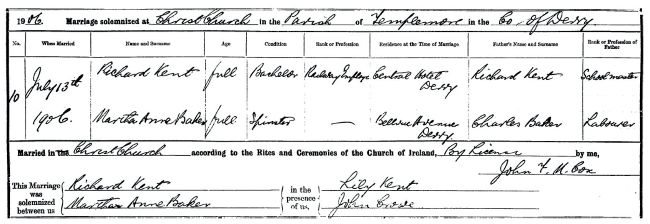
The marriage certificate of Richard and Martha in 1906 showed the first discrepancy, stating Richard’s father to be a schoolmaster: Richard Snr was a prison warder.
In 1882, Harriet Ure, the sister of my greatgreat-grandmother, married Richard Strahan Kent, a prison warder, in Dublin. The couple had 7 children and Richard’s job took them to Derry, Armagh and Belfast city. They never again lived in Dublin.
On both of the extant censuses (only 1901 & 1911 survive for Ireland), the family lived in Derry, but on each one their eldest son, Richard, was absent. Where was he? This investigation led me all over what is now Northern Ireland and to London, reviewing many kinds of records, but was I looking at 2 people who had the same name or one man? This article examines this possibility and the conflicting evidence.
STARTING …AT THE ENDING
Let’s start at the end. Richard Kent, Snr, died in 1929. His address was 38 Perth St, Belfast, but he died on a visit to his now married daughter, Elizabeth Hastings, in Drogheda, Co. Louth. I obtained his will from PRONI, the Public Record Office of Northern Ireland, which was for some reason invalid and processed as an intestacy. The administration notes that Elizabeth Hastings was his ‘lawful daughter and only next of kin’.
So Richard’s other 6 children were dead, as was his wife. I already knew about 3 daughters who hadn’t survived childhood, and son, William, who died at Gallipoli. The youngest son, Jonathan, died of peritonitis aged 23. Harriet died at the same Belfast address in 1924. But where was Richard junior? He should only have been 45 by 1929. There were no matching deaths in either Northern Ireland or the Irish Free State (as it was known before it became a Republic in 1949).