How to undertake a SUCCESSFUL GRAVEYARD RESEARCH TRIP
Alison Spring takes a look at getting the most out of visiting your ancestor’s final resting place, sharing some ideas to get you thinking about how to tackle what can be a challenging task for genealogists
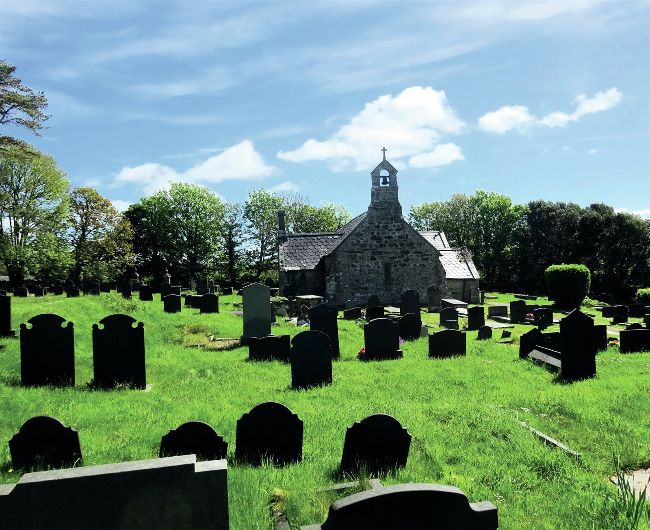
The graveyard at St Beuno’s Church, Trefdraeth, Wales
Before you go…
It’s important to be properly prepared for a trip to search in a graveyard.
Speak to any of your relatives who may know the whereabouts of family graves. There may be someone who has plot records or other related paperwork, like funeral programmes, newspaper clippings, or copies of undertakers’ documents. Your relatives might even be able to show you where some of the family burial sites are.
Having the right equipment is crucial. I would advise you to choose footwear appropriate for rough terrain, especially if you aren’t familiar with a particular cemetery. Many burial grounds can be overgrown and somewhat insect-infested, so clothing that keeps your skin covered is a good idea. Insect repellent can also be useful, especially in Scotland, where midges are a particular hazard. If you’re planning to spend a reasonable amount of time walking around, take plenty of water to drink. A notepad and pen/pencil, smartphone, or camera is essential. Make sure any electronic devices you plan to use are fully charged, and just in case, take a charger and/or cable with you. See the section on page 53 about recording headstones for more on the best methods and equipment to use.
Identifying the site
If you don’t have anyone in the family to be your graveyard guide, there are quite a few alternative ways to help you identify historic graveyard locations. For maps, I recommend the National Library of Scotland’s Maps https://maps.nls. uk. This website doesn’t just cover Scotland, but the whole
of the UK, and its historic collections may allow you to pinpoint burial grounds which are no longer in existence. Ordnance Survey (the official UK Government mapping organisation) provides free access to contemporary maps at
https://osmaps.ordnancesurvey. co.uk/?referrer=NEW_OS_ MAPS
as well as an app to purchase for your mobile device, with a free seven-day trial. GENUKI
www.genuki. org.uk/
may give names and/ or locations of burial grounds in a parish or county you are researching. Check that the information is current, especially crucial details like opening hours, by contacting the local church, council, or family history society. Their contact details may also be found on GENUKI or, for the latter, through the Family History Federation
www. familyhistoryfederation.com/societies-az
or the Scottish Association of Family History Societies
www.safhs.org.uk/ members.php.