WEB 3.0
Build a club on the next-gen web
Follow along with Mats Tage Axelsson as you assemble your first Web 3.0 application using Solidity and JavaScript!

Mats Tage Axelsson is digging through the web to find what may surface. It may be new, but always with an angle to help you better navigate your digital life using Linux.
OUR EXPERT
Onthe current web there are a few, enormous companies that dominate your activities and collect your data. For many of us this is a worrying development that we need to do something about. One technical solution is to develop a new version of the web. How that will look is still a mystery.
To get a grip on the efforts to reinvent the web, you should start by looking at distributed solutions. File systems such as IPFS can give you autonomy over your data. In most efforts, blockchain technology is also involved. In this article you’ll learn more about the Ethereum blockchain (see the feature in LXF292) since it’s the biggest and most popular option. However, it’s not the only game in town.
Other efforts aim to cut costs, and improve speed and scalability. There are also many efforts to use what’s called Layers to avoid using many transactions on the chain. These aim to stay off the chain while retaining many features of the technology.
Build it and they will come…
The code here will be a base for further development. As a first step, we’ll make it possible to add club members and manage memberships. This uses the OpenZeppelin code for access and governance. To make this happen you can use many other components but these are welltested and are sure to work as expected.
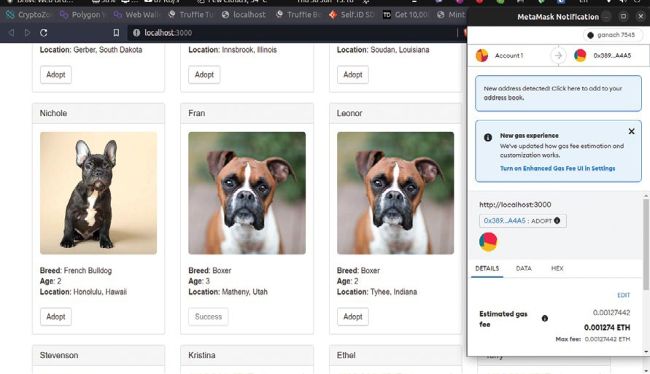
You can see a practice code running on the Ganach local blockchain. This project is available at
https://trufflesuite.com/tutorial.
You can obtain the latest code for this project from Mat’s Git at https://github. com/matstage/ Solidity-Club.
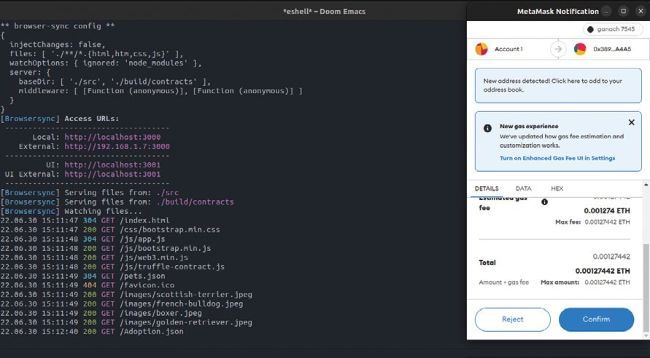
When using Emacs, you can run the server called ganach and a web server in a terminal buffer, which makes debugging much easier.
You’ll deploy your contract using one user and there must be another user to test if it can block access to other users. In the beginning you do this directly with the contract. Later you can have several users or wallet addresses to access this contract.
To edit your code, you need to choose an editor and a development environment. The environment needs to support both code linting and a compiler. It also needs to be a running chain and web environment that can make it look as if you’re on the web when you’re running your tests.
A wallet for your browser will also be useful for final testing. Metamask is the most common wallet, although many browsers now have their own wallets.