THE SALES CURVE
In a male-dominated industry, businesswoman Jane Cavanagh was able to create The Sales Curve from nothing in the late-Eighties. The company became highly regarded for its impressive arcade conversions and original efforts like SWIV. The Sales Curve was built into a hugely successful multimillion-pound UK videogames company that became a plc by the mid-Nineties. How was it done?
WORDS BY RICHARD HEWISON
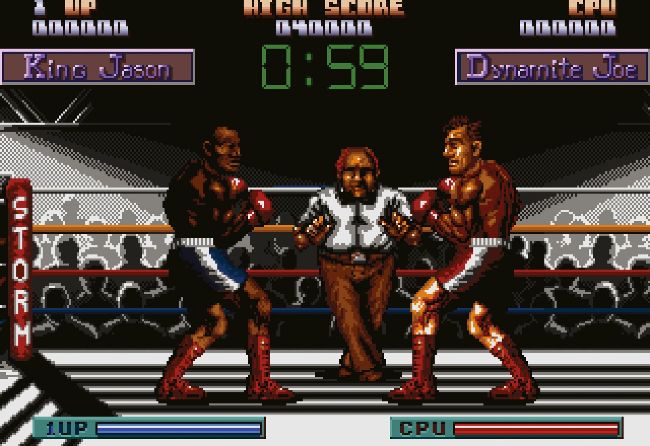
» [Atari ST] Final Blow was a decent attempt to convert a coin-op that featured huge character sprites.
Jane Cavanagh worked at Firebird Software in the mid-Eighties as a business development manager, getting its games into overseas territories and signing several arcade titles for home conversions, including Bubble Bobble and Flying Shark from Taito. Jane then got the opportunity to set up on her own in late 1987, as she explains.
“The original plan was to represent companies who didn’t have any presence in the UK. Our first client was France Image Logiciel (FIL). They wanted me to acquire some arcade licences and develop products based upon those licences, which they would then distribute around Europe.”
Among the titles The Sales Curve signed were Silkworm and Gemini Wing from Tecmo, Continental Circus and The Ninja Warriors from Taito, and Shinobi from Sega. She needed to find someone to run the development side, and news that Jane was looking for a development director reached Darren Melbourne, who had only recently left defunct games publisher Nexus.
“Obviously I thought I could do it,” laughs Darren. “To get the job I basically told her a pack of lies! I said I knew everyone in the industry, that I could easily do it standing on my head, and thankfully she gave me a chance.”
50 Lombard Road in Battersea became The Sales Curve’s office, and at the start there was just Darren and Jane. Shortly afterwards, Graham Wayne joined from Telecomsoft, and when various arcade boards arrived, Darren knew just the person to get them working. Having worked in a hobbyist board-game shop, Matt Spall had a passion for gaming, and he regularly attended the local London computer shows, getting to know people in the industry. He was working as a postman in London’s West End when opportunity came knocking.
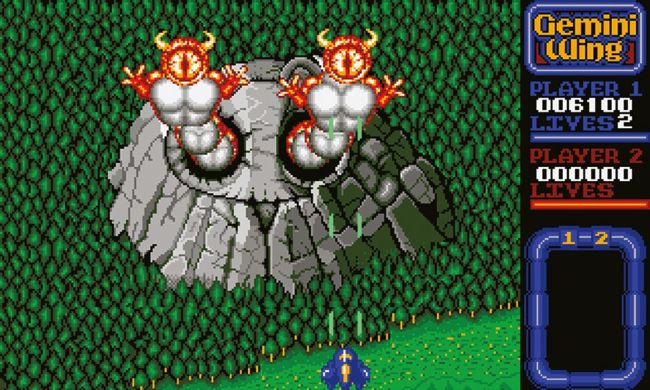
» [Amiga] Bright, colourful and cartoony-style graphics made Gemini Wing less attractive to some arcade shooter fans.
“One afternoon, I was just back home from a morning’s postal delivery and my doorbell rang,” he says. “To my surprise, Darren Melbourne was standing there. He’d just started working at The Sales Curve, about five minutes’ walk from my place, next to Battersea heliport, and he asked if I fancied coming into the office to have a look around. I jumped at the chance.”
The office only contained a few desks and an Apple Macintosh. In one corner was an arcade cabinet and several arcade boards. Where Matt shone was his understanding of electronics, and he got working on the various JAMMA arcade boards that had been licensed. Initially, Matt visited the office a couple of times a week, whilst continuing with his early morning postal shift, as he explains. “I finished as a postie by one o’clock, so I was usually at The Sales Curve an hour later, often still wearing my uniform!”