AU
  
You are currently viewing the Australia version of the site.
Would you like to switch to your local site?
13 MIN READ TIME

Can Anything Save Us from Unintended Consequences?

Stuart Vyse is a psychologist and author of Believing in Magic: The Psychology of Superstition which won the William James Book Award of the American Psychological Association. He is a fellow of the Committee for Skeptical Inquiry.

Quick quiz: What caused the Great Recession of 2008?

OK, I admit it. That’s an unfair question. It was complicated. If you’ve done some homework, you might be able to mumble something about a housing bubble, subprime lending, mortgage-backed securities, credit-default swaps, big banks, irresponsible borrowers, George W. Bush, Barack Obama….

But there is one thing I can be fairly certain you will not mention: the Bankruptcy Abuse Prevention and Consumer Protection Act of 2005 (BAPCPA). You may not have heard of BAPCPA or, if you have, it may only be a foggy memory. So, here is a little history:

In the 1990s, personal bankruptcies were rising sharply, and the banking industry began a lobbying campaign to stiffen the bankruptcy requirements—a move that was expected to increase the profits of credit card companies. Attempts to pass a bill failed until President George W. Bush was reelected in 2004. Finally, after big banks spent $40 million in campaign contributions and millions more in lobbying efforts, the bill went into effect in late 2005 (Labaton 2005). It had a number of provisions, but most importantly it increased the up-front costs of filing for bankruptcy and made the process more onerous.
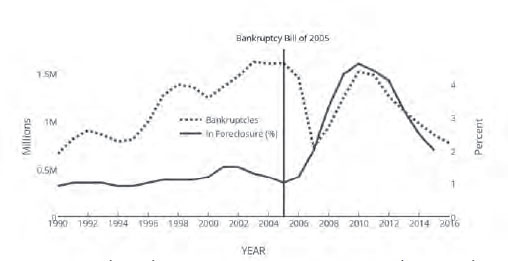
Figure 1. Nonbusiness (personal) bankruptcies and percentage of homes in foreclosure (right-hand axis) for the years 1990–2016. The vertical line marks the implementation of the Bankruptcy Abuse Prevention and Consumer Protection Act of 2005.
Sources: U.S. Courts and Mortgage Bankers Association.

Of course, people should pay their bills. We all should live up to our responsibilities. But, as President Obama was fond of saying, America is a nation of second chances (Obama 2016). Bankruptcy is designed to give people a “fresh start,” a chance to right their financial ships. Furthermore, it often works as intended. While writing a book about the psychology of spending and debt, I met a number of people who went through bankruptcy and were able to get their lives back on course. However, the money written off in bankruptcy cuts into the profits of credit card companies and other lenders and keeps interest rates high; so the banks lobbied to make the bankruptcy requirements more difficult. Little did they know what would happen next.

Although it took a few years to figure out, several economic studies now conclude that the BAPCPA was a precipitating factor in the ensuing debacle of 2008 (Albanesi and Nosal 2016; Li et al. 2011; Morgan et al. 2012). According to these investigations, once the new bankruptcy requirements went into effect, many people who were struggling with debt found bankruptcy was no longer an option. Ironically, they could no longer afford to declare bankruptcy. But what remained an option was not paying the bills, and beginning in 2007, a little over a year after BAPCPA went into effect, an increasing number of homeowners chose to stop paying the biggest bill of all—the mortgage. The switch from bankruptcies to foreclosures can be seen in Figure 1.

Read the complete article and many more in this issue of Skeptical Inquirer
Purchase options below
If you own the issue, Login to read the full article now.
Single Digital Issue July August 2017
 
$4.49 / issue
This issue and other back issues are not included in a new subscription. Subscriptions include the latest regular issue and new issues released during your subscription. Skeptical Inquirer
Annual Digital Subscription $25.99 billed annually
Save
4%
$4.33 / issue

This article is from...


View Issues
Skeptical Inquirer
July August 2017
VIEW IN STORE

Other Articles in this Issue


Editor’s Letter
Te Fires of Creationists, and Rallying for Science
You have to hand it to the creationists, especially the
NEWS AND COMMENT
Academies Report Urges Bolstered Efforts to Protect Integrity of Science
The scientific enterprise places high value on honesty and openness
A Scientist Pushes Psychology Journals toward Open Data
The March 9 Nature reported some disturbing news: “An editor
Burzynski Sanctioned by Texas Medical Board
On March 3, 2017, the Texas Medical Board sanctioned Houston
Hans Rosling Brought Data to Life, Showed Our Misconceptions about the World
Many skeptics outside Sweden first encountered Professor Hans Rosling at
Humanities, Too: In New Study, History Courses in Critical Thinking Reduce Pseudoscientific Beliefs
We often think of the need for critical thinking in
INVESTIGATIVE FILES
Murder by Darkness: Does Mammoth Cave’s Specter Harbor a Secret?
Joe Nickell, a former magician and private detective, did graduate
A MAGICIAN IN THE LAB
The Farce Known as ‘FC’
James Randi began his career as a stage magician and
NOTES ON A STRANGE WORLD
The Monster of Florence: Case Closed?
The Terrifying Story of the Most Infamous Ritual Murders in Italian History, Part 1
THE SCIENCE OF SCIENCE COMMUNICATION
The March for Science
Partisan Protests Put Public Trust in Scientists at Risk
SKEPTICAL INQUIREE
The Phoenix Driveway Ghost
Benjamin Radford is a research fellow at the Committee for
FEATURES
FIRE-BREATHING DINOSAURS?
Physics, Fossils, and Functional Morphology vs. Pseudoscience
DID AUSTRALIA’S ABORIGINES SEE PLESIOSAURS? YES-IN A CHILDREN’S BOOK
To support their claim that humans and plesiosaurs coexisted, antievolution publications cite as evidence a plesiosaur painting by an artist of the Kuku Yalanji tribe of Australia. However, the painting is actually a copy of an illustration in a 1960 children’s book on dinosaurs
JonBenet Murder Mystery Solved? (Not by Psychics)
The death of six-year-old beauty queen JonBenet Ramsey went unsolved for two decades. Psychics were worse than useless, but the author’s proposed solution resulted from evaluating the best evidence
‘Psychic Detective’ Noreen Renier: The Grinch Who Stole Christmas from a Grieving Family
August 12, 1989, was to be a joyous day for
The Danger of Chromotherapy
Despite the lack of scientific evidence for its effectiveness and its use of esoteric theories to describe its mechanisms of action, chromotherapy has become popular. But is it safe?
An Investigation of the Missing411 Conspiracy
In his “Missing411” series of books, author David Paulides claims that people are going missing from U.S. national parks under unusual circumstances and the National Park Service is obstructing attempts to investigate. What are the facts?
BALLES PRIZE
Maria Konnikova Wins CSI’s Balles Prize in Critical Thinking for The Confidence Game
In her acclaimed bestselling book The Confidence Game: Why We
REVIEWS
Why We Often Get Risks Wrong
Getting Risk Right: Understanding the Science of Elusive Health Risks
A Good Analysis of Bad UFO Information
By Robert Sheaffer. CreateSpace Independent Publishing, 2016. ISBN: 978-1519260840. 292
The Bigfoot Obsession
Monster Trek: The Obsessive Search for Bigfoot. By Joe Gisondi
NEW AND NOTABLE
[ NEW AND NOTABLE
Listing does not preclude future review
LETTERS TO THE EDITOR
[ LETTERS TO THE EDITOR
Your March/April 2017 issue has provoked me to make an
THE LAST LAUGH
THE LAST LAUGH
Chat
X
Pocketmags Support