JAGUAR F-PACE
Best-seller gets a cabin makeover and now flexes big PHEV muscle, but to what effect?
ROAD TEST No 5552
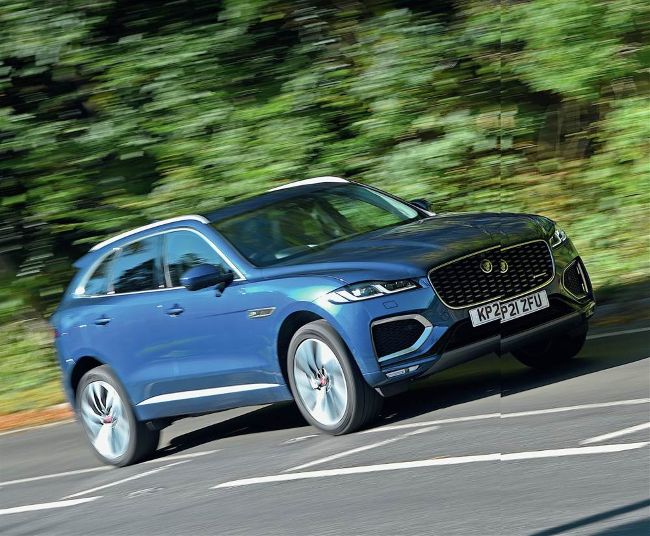
PHOTOGRAPHY WILL WILLIAMS
We like
• Interior is transformed
• Rapid, with the potential for great fuel economy
We don’t like
• Expensive compared with other plug-in SUVs
• Electric range is only average
O ur original road test of the Jaguar F-Pace in 2016 began by discussing how wary Jaguar was of introducing an SUV. Traditionally known for luxury saloons and sports cars, it feared a backlash from what might seem like a drastic change of character. Today, that thought seems almost naive, because SUVs have taken off in popularity, making the F-Pace one of the few Jaguars in recent years that could be considered a success story. As the world has lost its appetite for saloons and estates, and made cars like the XE and XF critical successes but commercial slow-burners, the F-Pace has played a key role in keeping Jaguar af loat.
Two decades of trying to chase the German premium brands haven’t worked out well for Jaguar, then. But now Jaguar Land Rover CEO Thierry Bolloré is changing tack in a major way: Jaguar will become a pureelectric sub-Bentley luxury brand by 2025. Until then, its existing models need to continue to earn their keep.
All of them have had facelifts with drastic interior revamps and some major powertrain shake-ups. With that previous focus on the German brands came big investment in JLR’s own range of Ingenium diesel engines. With hindsight, that now looks like the wrong direction to have taken, of course, but in recent years the firm has gone full steam ahead in developing plug-in hybrids as well.
To see how successful this effort has been, we’re revisiting its most popular model, the F-Pace, with arguably what is now its most important powertrain: the P400e petrol-electric plug-in hybrid.
DESIGN AND ENGINEERING
As you’d expect with a facelift, the underbody structure of the F-Pace remains the same. The car’s platform is shared with the XE and XF and is still composed of mainly aluminium, although that construction somehow fails to translate into a particularly low kerb weight. The lightest F-Pace, the P250, with its four-cylinder petrol engine, still weighs 1822kg. Add in a 17.1kWh battery, an electric motor and the associated electronics for the hybrid system, and that rises to 2114kg for the P400e, which is heavier even than an all-steel, sevenseat Kia Sorento PHEV. On our scales, fully fuelled and fitted with plenty of options, our test car turned out to be 150kg heavier still, at 2264kg.
This platform wasn’t originally conceived with electrification in mind, so the packaging was never going to be ideal (more about this later). The engineers nevertheless managed to squeeze in a 17.1kWh battery pack, of which 13.7kWh is usable in EV mode. Providing the rather substantial 398bhp are the 296bhp 2.0-litre petrol engine in the P300 tune familiar from the XE, XF and F-Type, and a 141bhp electric motor. That’s a good deal more firepower than either the BMW X3 30e or Mercedes-Benz GLE 300e. The car is also rated to tow two tonnes – plenty for a hybridised SUV.