AUTOCAR ROAD TEST No 5621
DS 7
Stellantis luxury brand adds performance range-topper to facelifted SUV
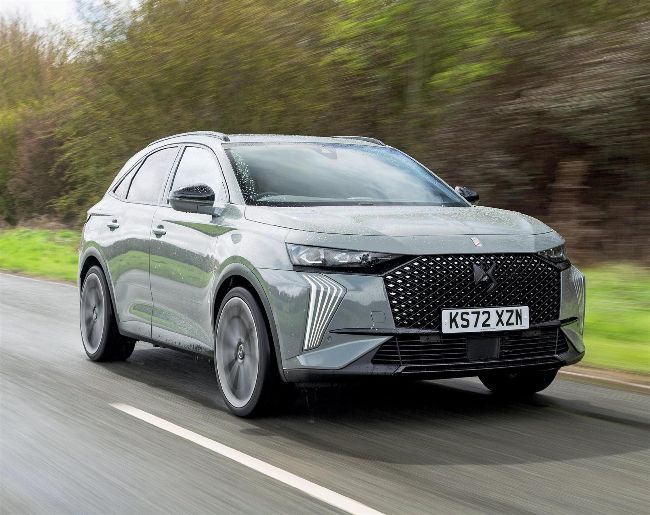
PHOTOGRAPHY LUC LACEY
MODEL TESTED E-TENSE 4x4 360 LA PREMIERE
Price £59,190
Power 355bhp
Torque 384lb ft
0-60mph 5.7sec
30-70mph 4.6sec
Fuel economy 37.6mpg
CO 2emissions 40g/km
70-0mph 45.0m
We like
• Roomy and plush interior
• Dynamically competent
We don’t like
• Powertrain is unwilling and doesn’t feel that quick most of the time
• Poor ride quality
Until batteries become sufficiently advanced to provide decent stamina and energy density, it looks like the way forward for the performance car is plug-in hybrid technology.
The Mercedes-AMG C63 is swapping its V8 for a PHEV fourcylinder, the BMW XM sticks with a V8 but adds 29.5kWh of batteries, the next M5 is likely to do the same, the fastest Porsche Panamera you can buy is the Turbo S E-Hybrid, and the Ferrari 296, McLaren Artura and Lamborghini Revuelto also use rechargeable batteries and motors to augment their piston engines.
In the slightly less rarefied sphere, Stellantis has had much the same idea for the past few years. It started with the Peugeot 508 PSE, whose engine and motor combination made the prospect of a 350bhp Peugeot a reality. The idea is not just to produce lots of power, but also to ensure that you’re not out of pocket on taxes if you want to run something a bit interesting as a company car.
The next step in that strategy involves the DS Automobiles luxury brand, which has come up with the DS 7 E-Tense 4x4 360. The DS 7 has been facelifted as well as gaining this new performance version, so let’s see if it can solve some of the outgoing car’s issues, and successfully marry a degree of sportiness with DS’s promise of refinement.
DESIGN AND ENGINEERING
Along with the facelift’s aesthetic and mechanical changes, the DS 7 Crossback also loses its epithet. DS is eliminating the ‘Crossback’ moniker for its SUVs because there are no longer any competing model names since the death of the DS 3 hatchback. Instead, it is stepping up its efforts to create brand awareness by spelling out ‘DS Automobiles’ across the tailgate.
Aside from the new badging, you will recognise the facelifted DS 7 from its new headlights. The xenon headlights that would do a little dance on start-up were a key feature of the Crossback, but those have been replaced with more conventional LED matrix headlights. From the main light clusters tumble the new ‘DS Light Veil’ daytime-running lights, which use a laser-etched polycarbonate surface that is painted on the inside to give the illusion that light just shines through the bodywork.
The powertrain isn’t entirely new either, being an evolution of the one in the Peugeot 508 PSE. It’s the same 197bhp 1.6-litre turbocharged four-cylinder that is found in countless Stellantis hybrids, assisted by a 107bhp motor in the gearbox and a 111bhp motor on the rear axle. What is different is that, at 14.2kWh (12.9kWh usable), the battery is bigger than what you get in the Peugeot or in the E-Tense (DS’s naming for EVs and plug-in hybrids) versions of the outgoing DS 7 Crossback. The 355bhp engine-motor combination has also surfaced in the DS 9 360, but so far that hasn’t made its way to the UK.