BMW X7
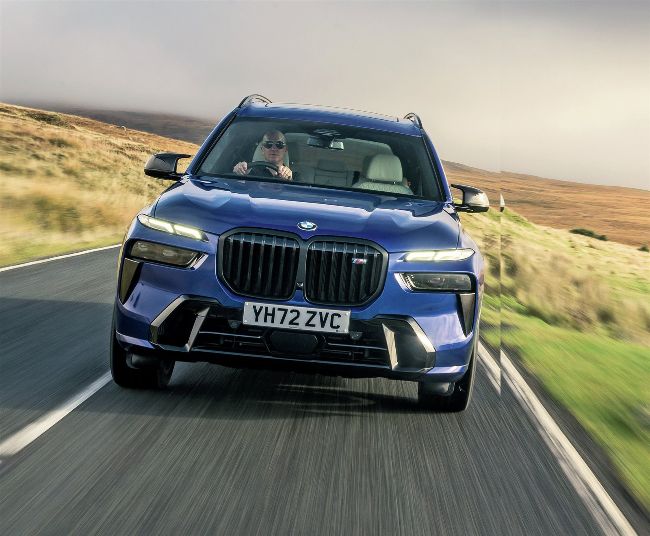
Broader changes for BMW’s flagship SUV are spearheaded by an M-lite, V8 special
MODEL TESTED M60i XDRIVE
Price £108,935 Power 523bhp Torque 553lb ft 0-60mph 4.2sec 30-70mph in fourth 5.2sec Fuel economy 20.7mpg CO 2emissions 276g/km 70-0mph 45.2m
PHOTOGRAPHY MAX EDLESTON BMW X7
We like
• Finely judged blend of everyday ride quality and uncanny B-road handling
• Wants nothing for performance – awesomely quick but not frighteningly so
• Good visibility, endless space and opulent materials make for a calming atmosphere
We don’t like
• Doesn’t cosset occupants with quite the other-worldly serenity of a Range Rover
• Lacks the tactile helm of Porsche’s Cayenne and seems distant at times
• Not the overtly sporting SUV some will want, though others will love it for this
Nobody could dispute that BMW has got the bit firmly between its teeth concerning the business of fast, brash SUVs. How firmly is something that becomes apparent when you consider that the 523bhp, £109,000 X7 M60i tested here isn’t even the fastest, brashest BMW SUV you can buy, or even the second-most – step forward the new M-bespoke 653bhp XM and the recently upgraded 628bhp X5 M.
But, of course, the X7 M60i’s remit is not simply to be as fleetfooted and dynamically able as it’s possible for BMW to achieve. It must also be endlessly practical and lavishly comfortable. There is an overlap with the 7 Series limousine here, which is an element neither of the hottest X7’s uber-powerful stablemates need worry about. They need only be fast and brash.
So who are the chief rivals of this wide-ranging SUV? Given this is such an expensive and niche recipe, there are a surprising number. Most notable is the latest Range Rover, the current class benchmark for both off-road marauding and rolling refinement back on terra firma. However, as a BMW and an M-lite one at that, the seven-seat X7 M60i needs to fight convincingly well on broader fronts. In dynamic terms, owners will expect it to be an alternative to the Porsche Cayenne, only with the all-round usability of Audi’s Q7 and the everyday opulence of the Mercedes GLS. In fact, there’s an argument to be made that, in V8-engined flagship M60i guise, the X7 has the toughest job in the segment. So can it rise to the occasion, or will it prove as divisive to drive as to look upon?
DESIGN AND ENGINEERING
BMW’s move to a split-headlight design for the X7 marks out the facelifted model, though fundamentally the car remains unchanged. A full-size SUV with the option of seven seats, the X7 is the largest car BMW makes and comes with a choice of six- or eightcylinder engines, all paired with an eight-speed automatic gearbox and variable four-wheel drive.
However, look beyond the headlights, the redesigned kidney grille and, if specified, the new 23in alloy wheels that are the biggest ever fitted to any BMW, and there are some meaningful changes. One of them is the adoption of 48V mild-hybrid technology, which is found on both the 375bhp xDrive40i 3.0-litre six-cylinder petrol and its 335bhp diesel counterpart, as well as the 523bhp 4.4-litre V8 tested here. On the six-cylinder petrol, the system can even provide all-electric driving at very low speeds, though in all cases it contributes to overall torque output. Note also that the X7 M60i marks a relatively low-key debut for M’s new S68 engine, with its cross-bank exhaust manifold. It is likely to resurface in the next M5.