ROAD TEST No 5543
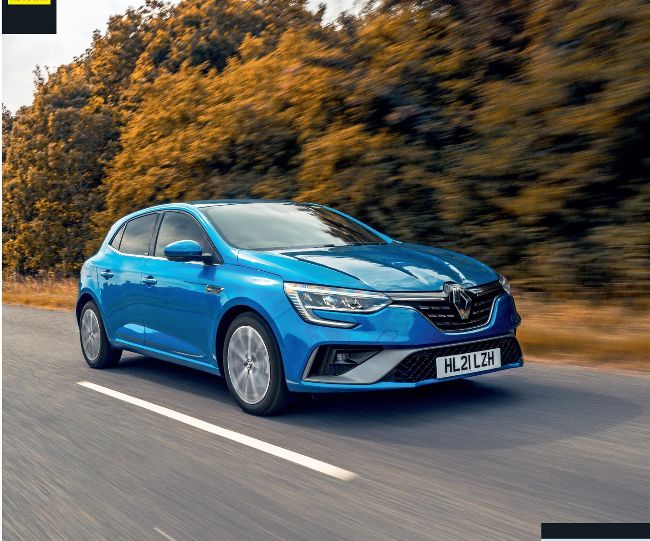
Renault Mégane
Ageing hatchback gets a novel hybrid system to see out its twilight years
MODEL TESTED E-TECH PLUG-IN HYBRID 160 RS LINE
●Price £31,495 ●Power 158bhp ●Torque na 0-60mph 8.6sec ●30-70mph in fourth na ●Fuel economy 60.1mpg CO ●2 emissions 28g/km ●70-0mph 50.2m
PHOTOGRAPHY OLGUN KORDAL
We like
• Fascinating drivetrain concept works smoothly and unobtrusively
• Comfortable ride and good noise insulation
We don’t like
• Interior is short on space, and looks and feels dated
• Lacks the latest active safety features
With the launch of the pure-electric Zoe in 2012, Renault was one of the first brands to create a credible EV for the European market. In the ensuing years, things remained quiet around electrification at Renault while other manufacturers launched hybrids, plug-in hybrids and fully electric models.
And now, as the current Mégane is due to be replaced by an all-electric successor and EVs are generally gaining ground, Renault has launched a plug-in hybrid version of the recently facelifted outgoing model. In fact, the brand has rapidly pivoted from hybrid sceptic to hybrid believer, as it adds E-Tech hybrid and plug-in hybrid versions to the line-ups of most of its models.
It has also turned into a defender of the hybrid, with the firm’s leadership recently telling Autocar that the European Commission’s proposed ban on hybrids in 2035 may come too soon, particularly for the cheaper end of the market that Renault subsidiary Dacia operates in. As the facelifted Mégane undergoes our road test, the question is whether the technology is worth defending.
Renault must certainly think so, because the E-Tech plug-in hybrid is now the only Mégane you can buy. The full Mégane range received a facelift in 2020 that brought some subtle styling tweaks and a muchneeded overhaul of the infotainment, but the petrol and diesel versions proved short-lived, with all except the plug-in hybrid removed from sale earlier this year.
The current-shape Mégane is likely to disappear not too long after its pure-electric successor arrives, but the E-Tech powertrain is set to become a mainstay of the Renault – and perhaps Dacia – line-up, so it’s worth taking a closer look.
DESIGN AND ENGINEERING
★★★★★
If nothing else, the concept of the E-Tech powertrain, whether in full hybrid or plug-in hybrid form, is an interesting one. With battery-electric vehicles, we may be heading into an era of mechanical uniformity, but hybrids are providing room for engineers to come up with novel concepts. With its clutchless, unsynchronised four-speed automatic gearbox, Renault’s might be the most novel of them all.
The Mégane is a plug-in hybrid, but the conventional hybrid powertrain found in the Clio and new Arkana E-Tech is essentially the same save for a smaller battery and a less powerful electric motor. All use a naturally aspirated 1.6-litre four-cylinder engine paired with one big electric motor and one smaller unit acting as a starter-generator.
As the gearbox is clutchless, the engine cannot be decoupled – only put in neutral – so the car always sets off on electric power to get around the fact that a petrol engine cannot operate from zero RPM. To ensure there is always enough battery to do so, the engine can run the generator while in neutral. Once the car is up to speed, the engine can be engaged to any of the four ratios of the automatic gearbox, and to make sure there is no unseemly grinding of gears, the starter-generator adjusts the engine and input shaft’s RPM to match.