ROAD TEST
Ferrari SF90 Stradale
Ferrari's electrified era starts with a 987bhp plug-in supercar of epic capabilities
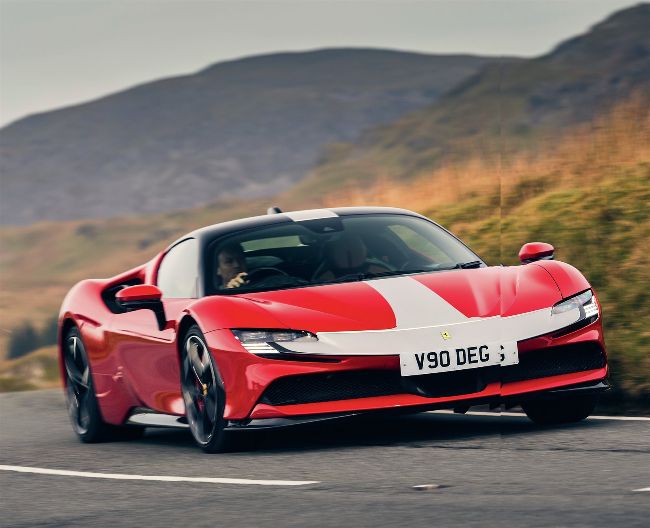
PHOTOGRAPHY LUC LACEY
MODEL TESTED SF90 STRADALE
Price £374,420 ● Power 987bhp ● Torque na ● 0-60mph 2.5sec ● 30-70mph in fourth 2.9sec ● Economy 24.4mpg (touring) ● CO 2 emissions 160g/km ● 70-0mph 38.5m
We like
• Towering outright performance and responsiveness
• Doesn’t limp or fade during prolonged circuit driving
• First-class integration of electric and petrol power across the whole speed range
We don’t like
• It’s bigger, wider and heavier than a typical V8 Ferrari – and feels it
• Limit handling isn’t as well resolved as Maranello’s usual standard
• Tokenistic cargo space really impacts usability
V iewed through the great prism of electrification by which the automobile is currently framed, the subject of this week’s road test, the SF90 Stradale, would seem to be most significant, because it’s the first plug-in hybrid model to be launched by the world’s defining purveyor of supercars of all shapes and sizes: Ferrari. But while it is accurate to think of it like that, this car has much greater and wider-reaching ambitions than simply to make the modern mid-engined Ferrari concept more responsible, more sustainable and more socially conscious.
Make no mistake about it: the SF90 is out to totally reinvent the technical rulebook that has governed the way in which Maranello has designed and executed so many of its cars over the past 30 years. It uses electrification innovatively and with real commitment in an attempt to surpass any dynamic expectation you might have of it, and not just to ace a lab emissions test or to keep the combustion-engined Ferrari alive for another decade or so. And that commitment, as you’re about to find out, becomes manifest in some pretty spectacular ways when you seek to gauge it with satellite timing gear.
The SF90 is billed by its maker as a paradigm shift for the supercar; something extreme on every level. And rather than some super-rare collector’s item or a fleeting special-series halo model, it becomes a long-term addition to the firm’s showroom range. With this car, Ferrari has put a V8 engine in its top-dog series-production model for the first time in 72 years. This is also the first four-wheel-drive sports car in Maranello’s history (if we count the FF and GTC4 Lusso as grand tourers). It also comes at a time of wider renewal for the brand of the prancing horse, with the line of mid-engined V8 models that started with the 360 Modena of 1999 and culminated with the Ferrari F8 Tributo of 2019 about to bow out and the all-new 296 GTB V6 hybrid set to succeed them.
We’re on the cusp of a new electrified era for one of the world’s most revered car makers, then. Time to find out how it begins.
DESIGN AND ENGINEERING
The SF90 – named in reference to its debut in the 90th anniversary year of the creation of Enzo Ferrari’s ‘ex-works’ Alfa Romeo racing team in 1929 – is based on a monocoque chassis tub built just over the road from Ferrari’s Maranello factory, by the company’s wholly owned Scaglietti coachworks subsidiary.
The chassis is of an entirely new design. It uses hollow aluminium castings and consists of new lightweight aluminium alloys and a carbonfibre rear bulkhead. It’s 20% stiffer in bending and 40% more torsionally rigid than any comparable tub that the company has used before, but it’s no heavier.
Ferrari offers the SF90 in closed-roof Stradale and convertible Spider bodystyles, the latter priced more expensively than the former and nudging through the £400k barrier.
The most significant optional feature is the Assetto Fiorano specification, which can be had on either body and adds uprated dampers, extra weight-saving body panels and suspension hardware, a larger rear wing and sticky Michelin Pilot Sport Cup 2 tyres. It will add just under £40k to your car’s price.
Other key options that might also be considered trim levels in their own right include carbonfibre wheels (£19,200), carbonfibre bucket seats (£5760) and twotone striped paintwork (£20,160).