ROAD TEST 5716
MINI ACEMAN
Electric supermini gets a higher-riding, five-door running mate
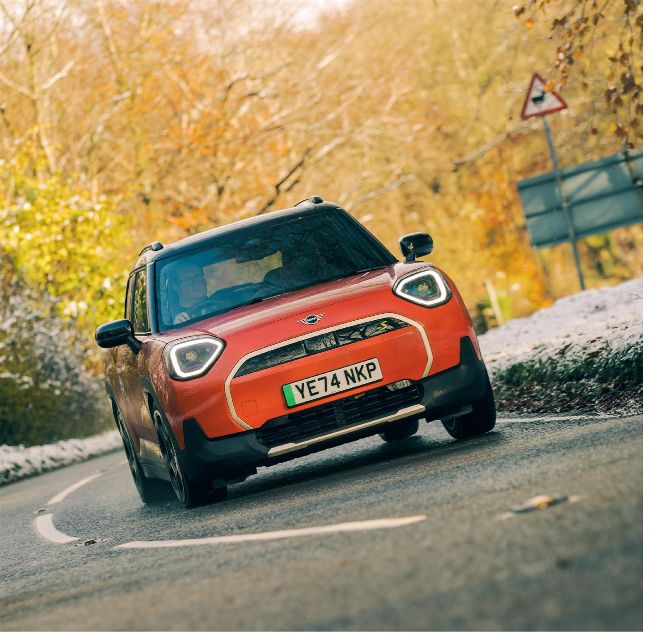
PHOTOGRAPHY JACK HARRISON
T
he Mini brand had a busy 2024, but the car to
which we now turn – the
Aceman – may well be its most important development among so many renewed siblings. That’s because the Aceman isn’t quite a natural successor for the short-lived Paceman three-door crossover of 2012, nor is it a differently named follow-up to the slow-selling Clubman pseudo-estate.
It is, instead, a new kind of Mini intended to perfectly plug the gap that has started to appear between the core Cooper hatchbacks and the C-segment-sized Countryman. And if it seems to assume something of a key significance, that may be because it was the scion Aceman concept, back in 2022, that gave us our first flavour of its maker’s current design language.
This is the car that aims, more than any other, to perfectly fuse trademark Mini dynamism and desirability with more pragmatic usability. Built exclusively by Spotlight Automotive (the BMW Group’s joint venture with Great Wall Motor) in Zhangjiagang, China, it is also the only model in Mini’s showroom catalogue to be exclusively wedded to electric power.
DESIGN & ENGINEERING
PROS Familiar-but-different Mini styling; choice of motor outputs
CONS Cooper derivation limits outright size, battery capacity and range
The Aceman is a four-metrelong, supermini-sized, jacked-up crossover, then, intended to rival anything from a Volvo EX30 to the recently announced Ford Puma Gen-E.
It is, in a rather simplistic sense, a stretched Cooper electric hatchback made on the same Chinese production line as the three-door-only supermini. Compare the dimensions of both cars and you will find that the Aceman is 80mm longer in the wheelbase than the Cooper, 221mm longer overall and just 54mm taller, making it small and fairly low-rise by B-SUV class standards. Standing next to one, you might simply take it for an only averagely large ‘regular’ supermini that just happens to be wearing its hiking gear.
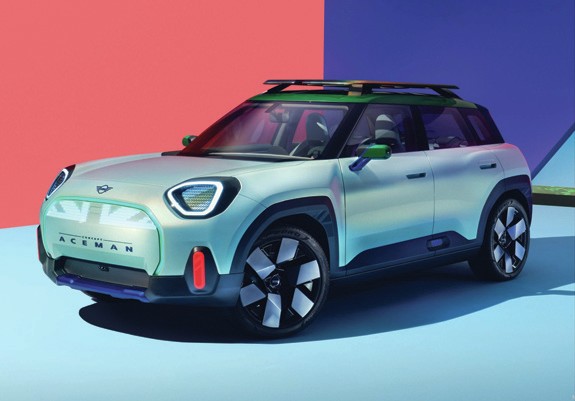
Concept car previewed Mini’s new era
Given the established technical relationship between the Cooper and Aceman, much of the rest of the mechanical content follows suit. It’s driven by one of the BMW Group’s favoured separately excited synchronous motors and, just as with the electric Cooper, that motor can supply 181bhp (Aceman E), 215bhp (Aceman SE) or 255bhp (Aceman JCW) to the front wheels, depending on how much zip you want your mid-sized Mini to command.
Drive battery packs are shared with the electric Cooper too. And so, while the kind of money that Mini is asking for some Aceman models will get you close to 80kWh of usable battery capacity or more from other compact EVs, in this one you get less than 50kWh (SE, JCW), or only 36.6kWh in bottom-rung E form.
Our SE test car came with a WLTP range of 244 miles, in a class where 350 miles and more is available. ‘Short-range and nippy’ may be a look that an electric Cooper hatchback wears comfortably enough, but on a new derivative that’s supposed to bring extra dimensions of usability, it doesn’t sit quite so well.