ROAD TEST No 5636
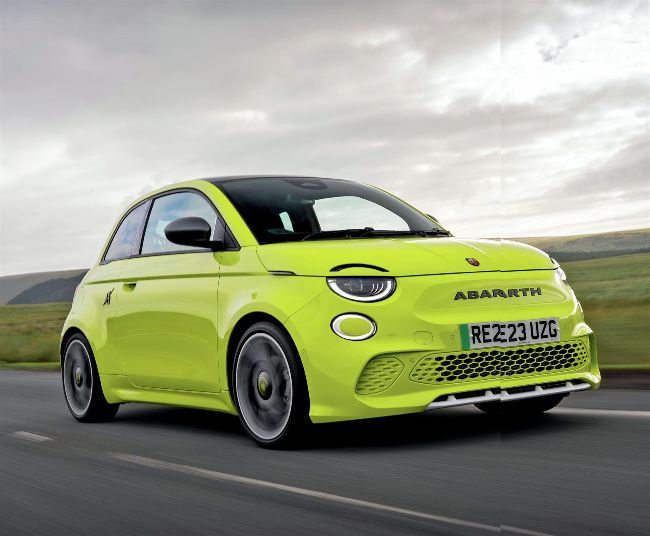
Abarth 500e
Batter y-powered 500 gets a dose of venom to blaze an electric hot hatch trail
PHOTOGRAPHY SIMON THOMPSON
MODEL TESTED TURISMO
Price £38,195 ● Power 152bhp ● Torque 173lb ft ● 0-60mph 6.9sec ● 30-70mph
6.4sec ● Economy 3.8mpkWh ● Max DC charging speed 86kW ● 70-0mph 44.6m
We like
•A small, light EV in a world of SUVs
• Decent steering and responsive handling
• Good efficiency
We don’t like
• Very expensive
• Lacks some throttle adjustability for a hot hatch
• Excitable primary ride
It often looks like modernity is killing the hot hatchback. Car makers are looking for bigger profit margins and thus to larger and taller cars. No more Fiesta means no more Fiesta ST; developing fancy bespoke suspension for something that needs to be affordable – well, there’s no point, really.
Meanwhile, rules for fleet CO2averages mean that manual, non-hybridised cars with highperformance engines sold in relatively large numbers could get car makers in hot water. So we’ve ended up with no hot Renaults or Peugeots, a Golf GTI that’s going auto-only next year and a £49,090 Civic Type R – which you can’t buy because it’s sold out. Praise be to Hyundai for keeping the flame alive with the excellent i20 N and i30 N. But there’s a glimmer of hope that modernity had to kill the hot hatch in order to reinvent it and bring it back: enter the electric hot hatch. Emissions legislation isn’t a problem with EVs. Extra power is easy to come by – crank up the motor or get a bigger one off the shelf. An EV’s weight isn’t ideal but the silver lining is that many of them have more sophisticated suspension as standard.
Perhaps there is still hope – and the first potential flicker of that optimism is the Abarth 500e, the go-faster version of the already surprisingly enjoyable electric Fiat 500. It’s the first quick version of an EV hatch to be very obviously positioned as a hot hatch, but it doesn’t quite have the market to itself. There’s still the Mini Electric, and in the class above sits the sweetly balanced Cupra Born and the 429bhp MG 4 XPower. Next year, we’ll see the Abarth’s most direct rivals, the all-new Mini Cooper E and a Renault 5-based Alpine A290.
DESIGN AND ENGINEERING
The Abarth 500e is obviously the fast version of the electric Fiat 500. That means it’s based on the same EV platform that FCA developed before the merger with PSA into Stellantis. The plan was to use it in a whole range of models, but things have turned out differently postmerger, since it became clear that the PSA architectures are the future for the group. Jeep’s new small electric crossover, the Avenger, sits on e-CMP2, and so does the 500’s big sibling, the upcoming 600.
So the Abarth 500e, like the Fiat base car, is a bit of a technological dead end, but that’s because circumstances conspired against it, not for any major shortcomings. It isn’t the most mechanically sophisticated EV, but hot hatches are often brilliant because of their simplicity rather than despite it.
There are MacPherson struts at the front and a torsion beam at the rear. The springs are stiffer than the Fiat’s and the dampers have been retuned. The standard 500e gets 17in wheels, while the Turismo sits on 18s. Both wear EV-specific Bridgestone Potenza Sport tyres.