BEST VALUE ECO UPGRADES
Keen to make your existing home more energy efficient? Nigel Griffiths takes a look at the top sustainable retrofit measures that will offer real bang for your buck
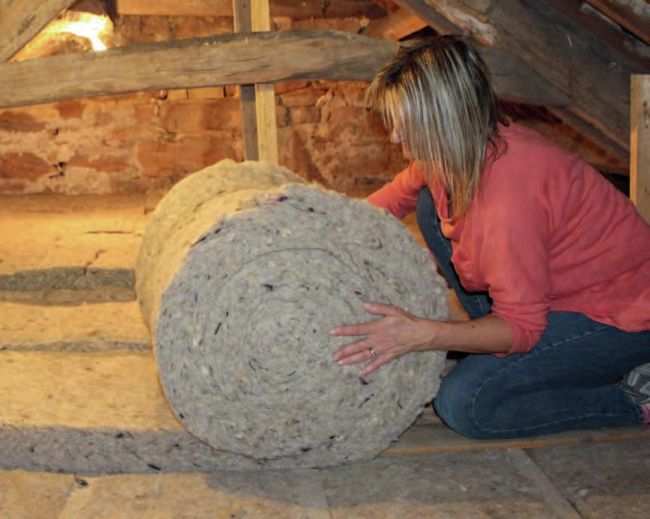
Above right: CosyWool British sheep’s wool insulation from Thermafleece (thermafleece.com) is a natural and breathable product that’s ideal for use in heritage homes.
ISTOCK.COM/NSJ-IMAGES
Money can be used as a yardstick for sustainability. How? Well, every time we spend money changing buildings, we are consuming resources. So, if an energy efficiency measure costs a lot but makes little difference in practice, not only is it a poor investment, it is also likely to be unsustainable. The embodied energy/carbon of making changes needs to be compared with the energy it will save in practice – it’s no good expending a lot to save only a little. I’m going to be looking at different upgrades in turn to give you a flavour of each. But it’s important to note retrofit measures should be not considered in isolation – and here’s why:
● What you do to one part of a building will inevitably affect how another part behaves.
● Measures to improve insulation can compromise ventilation.
● Insulation upgrades reduce heat demand and therefore can require changes to heating systems.
When trying to work out best value options, this means that the ultimate cost may not just be the measure itself. Associated works may be required in other areas. This is explored further in the box-out section on avoiding unintended consequences (right). Remember, every building is different and the most appropriate measures will vary even between similar buildings. That said, in general order of cost-effectiveness, the main upgrade options are as follows:
Draught proofing
This measure has become, rather unfairly, the poor relation of the retrofit world. Often ignored, it is almost certainly the most cost-effective measure in many buildings, especially for older homes where up to 30% of heat may be lost through air leakage. Draught proofing is not heavily promoted by industry precisely because it is so cheap. It does not involve huge resources or time (and labour) and in many cases it can be carried out as a DIY job.