BEHIND THE FACADE
Fiona and Martin Lamb bought a neo-Georgian residence with a view to renovating it. Little did they know, they’d end up building a brand new home behind the protected front elevation
WORDS JENNIFER GRIMBLE
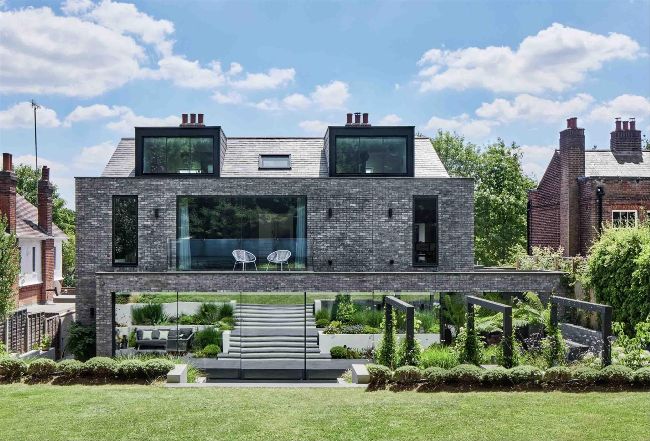
Three distinct zones – a ground-floor living space, first-floor terrace and loft with two symmetrical dormers – ensure the rear of the property contrasts with the traditional facade
PHOTOS DAN GLASSER & FIONA LAMB DESIGN
After having their third child, Fiona and Martin Lamb began searching for a bigger home to accommodate the whole family. The couple eagerly embraced the challenge of renovating a property to create their dream home. However, they hadn’t anticipated the full scope of work involved when they purchased a grand neo-Georgian house in Crouch End, London. “We’ve always done work on our previous homes and were prepared to roll up our sleeves and pitch in,” says Fiona. “We thought we were taking on a big renovation project, so we were anticipating some hard work ahead.”
While the 1920s house was liveable, it hadn’t been modernised in decades. It featured small, impractical rooms and poorly considered extensions that left the ground floor feeling disjointed. The rear of the property was also extremely dark. “The garden at the back sloped up into a steep bank, so it felt like being in a basement when you were in the back rooms,” says Martin. “But we loved the home’s location. It’s opposite playing fields, so there’s a lovely sense of space that you don’t tend to find very often in London.”
Recognising its potential, the Lambs knew they needed an architect to help them transform the outdated building into a practical and attractive family home. Their main aim was to create living spaces suitable for their busy day-to-day lives and to draw in more natural light. “Another important thing for us was to make the house feel like part of the garden,” says Fiona. “There’s a big, beautiful plot outside but you just couldn’t see it from inside the house.”
A change of plan
The couple initially approached three design firms and selected Mulroy Architects. “They’d done work for three of our friends, so we had good insight into them as a company and how they worked,” says Fiona. “They are also local, so knew the planning department well and understood what would be permissible. That was a big plus.” Chief architect, Andrew Mulroy, worked closely with Fiona and Martin to reimagine the property. “We knew roughly how we wanted the floorplan to work and had some good design ideas, but we needed Andrew to come in and make them a reality,” says Martin. “Initially, the plan was to renovate, but as the design developed, we realised we were actually altering the majority of the house.” To evaluate their options, Andrew proposed conducting a feasibility study to help them understand the necessary work and spending. An external company, Potter Raper, was hired to do early-stage cost modelling. The review examined whether it would be more costeffective and energy-efficient to renovate the existing building or to demolish it and start anew. “They looked at every aspect of the building and on almost every count, determined it would be more effective for us demolish and build something new,” says Fiona.