Airtightness checklist
Want to create a comfortable, low-bills new home? Minimising air leakage is a vital tool for energy-saving – here’s how to do it
An AeroBarrier seal underway in a project at first fix stage. The building is pressurised so the waterborne, vapour-permeable airtightness seal can seek out leakage points
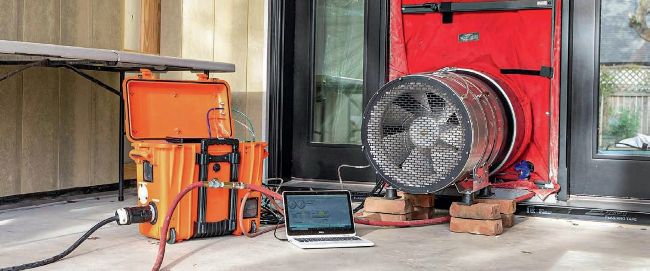
Good airtightness is critical to a successful lowenergy home. The better sealed a building is, the less air and heat can escape – and the fewer issues you’ll have with cold draughts coming in. So, improving airtightness will enable your heating system to work more efficiently, reducing bills and cutting carbon emissions. What’s more, modern houses are generally highly insulated, hence it will often be more cost-effective to address air leakage rather than wrap the whole structure in ever-increasing depths of insulation. Strangely, Building Regs are pretty relaxed on this point, allowing a massive 5m3 /h.m2 of air leakage to pass on the notional dwelling specification. That’s equivalent to a hole the size of five 20p coins for every 5m2 of surface area. Even the Future Homes Standard, currently being consulted on, is only expected to take that threshold down to 4m3 /h.m2 . Any bespoke home builder worth their salt should easily beat that figure. By contrast, the Passivhaus eco house standard puts a limit of 0.6 air change per hour (ach); a different measure, but it equates to a hole no bigger than a 5p piece for every 5m2 .
Getting there is more challenging than it mind sound, and most self builders will probably aim close to but not quite Passivhaus level. But whatever target you set, if you want to hit it, you’ll want to take a robust approach that ensures airtightness gets the focus it deserves from concept to completion. Here’s what to consider:
1 Assemble a knowledgeable team
Good airtightness starts with good design, so the key first step is to ensure you engage a suitably-experienced pro to develop the architectural plans and the technical detailing. This might be a certified Passivhaus designer or simply someone who can show you successful past builds.
Think about who’s doing the work, too. “If they’re a main contractor, do they have a track record of delivering the kind of results you’re aiming for?” says Hugh Franklin, head of AeroBarrier UK. “For instance, have they done a Passivhaus or something similar before, such as building to AECB CarbonLite standards?” To gain maximum confidence, check whether they use an approved group of trades for the follow-on work, too.