SLIDING DOOR COST GUIDE
Find out what makes a good quality sliding door system, and what you should budget to install it
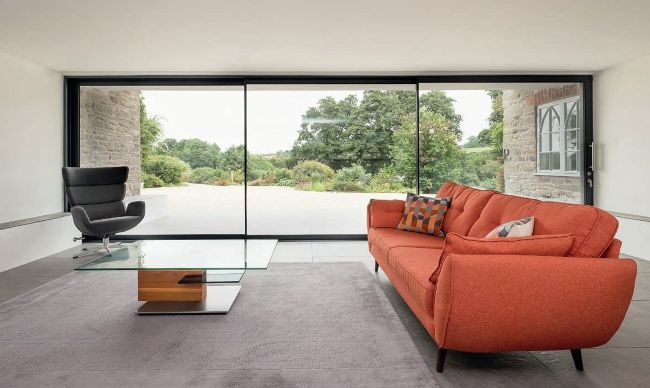
Above: A large, three-panel set of IDSystems theEDGE2.0 sliders installed in an extension to a period home in Herefordshire. The 7,495mm (W) x 2,409mm (H) system features panels approx 2,498mm wide, fitted with solar control, security laminate glazing and PAS 24 approved locks. Two of the panels slide, sitting behind a fixed frame when fully opened. An equivalent installation would start from around £14,800 + VAT (including fitting)
AR DESIGN STUDIO / PAUL CARTER PHOTOGRAPHY
Type ‘sliding door costs’ into to your favourite search engine, and you’ll be greeted with all manner of articles purporting to share accurate information on what you’ll pay for sliding doors. Trouble is, most of these rely on readily-available price lists from DIY stores and other entry-level suppliers. Many of these companies sell based exclusively on price, and offer only the most basic of sliding door designs, built with cheaper materials.
If you’re building, extending or renovating your own home, chances are you’re looking for good quality products that support your ambitions in terms of energy performance, aesthetics, durability, security and more. In other words, the bottom-end products won’t cut it – and price guides based on them won’t help you plan your budget effectively. In this article, we want to help you understand what it will really cost to install a good-quality system – the kind you’ll actually want to live with if you’re doing a project for yourself!
Build quality
Materials matter with sliding doors. There’s a good reason most quality products are either aluminium or composite (such as alu-clad timber or PVCu-clad aluminium). These systems offer superior strength and rigidity, so can cope comfortably with the big spans and panel sizes most people are looking for in sliding doors. What’s more, they do so in relatively slim profiles, giving you the best views out.
When it comes to windows, good plastic units offer a cost-effective, low-maintenance choice – especially for replacements – and modern versions can look impressive.
But doors are a different kettle of fish. They’re much larger, so it stands to reason they need to be more rigid and robust to ensure good service over their lifetime.
“It’s not just that PVCu isn’t as aesthetically pleasing for doors, with thicker sightlines,” says Matt Higgs, managing director at Kloeber. “Plastic sliders are more susceptible to movement and expansion/contraction – they’re not as stable as aluminium or composite designs.” It’s a similar story for timber; even engineered softwood versions can’t match the spanning capabilities, slender sightlines and ultra robustness of aluminium and composite products.
“For most homeowners, the two biggest factors are sightliness and energy performance,” says Craig Luff, managing director at Ecohaus. “The slimmest sliders look fantastic, with profiles of just 20mm-25mm, but they might not suit a really low-energy build.” Ecohaus’s ultra-slim Visiline thermally-broken aluminium doors can achieve a U-value of around 1.1-1.2 W/m 2 K, for example, which will suit many projects. Meanwhile, its composite lift-and-slide Internorm products get down to 0.7 W/m 2 K (ie Passivhaus levels of efficiency), but with thicker frame profiles.