CA
  
You are currently viewing the Canada version of the site.
Would you like to switch to your local site?
13 MIN READ TIME

Space lab Antarctica

SPACE LAB ANTARCTICA

Antarctica may be at the bottom of the world, but as the coldest, driest and highest continent on Earth, it’s ideal for observing the universe

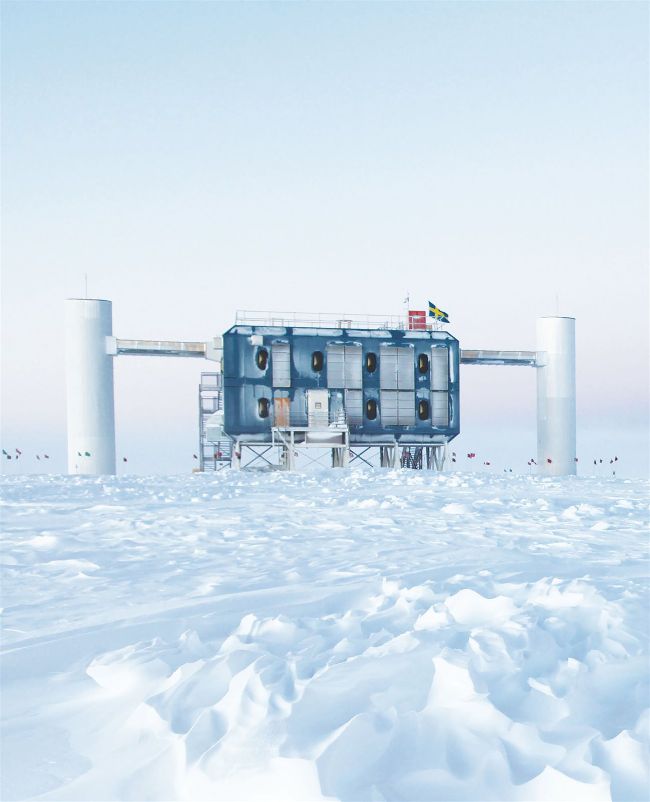
The South Pole Telescope (SPT) is the biggest in Antarctica

W rap up warm’ has long been a mantra among astronomers everywhere, given ‘ that so much observation of the cosmos has to take place out in the open and at night. However, if you’ve ever grumbled about surviving a few hours outside during a cold British winter night, just remember it could be worse – you could be in Antarctica, or even at the South Pole.

“I still remember the first time I flew down there,” says Kael Hanson, director of the Wisconsin IceCube Particle Astrophysics Center at the University of Wisconsin-Madison. “It was early November, which was just when the station opens for most people, and it was about -45 degrees Celsius (-49 degrees Fahrenheit). It was quite a shock just to get off the aeroplane and be out in that cold. It’s blinding bright too, unbelievably bright, because you have all this snow and everything is reflecting in your face. It’s also at altitude. The first couple of days you find yourself catching your breath. Sometimes you wake up sort of gasping for air, just because of the altitude. It’s an incredibly extreme environment to live in.”

Extreme it might be, but that’s what makes Antarctica and the South Pole such an ideal spot for setting up your telescope. According to theoretical physicist Francis Halzen, also of the University of Wisconsin-Madison, the South Pole now ranks with the grand research laboratories such as Fermilab and CERN. Astronomers ideally want somewhere cold, dark, remote and dry. Antarctica, and the South Pole in particular, fit the bill very well, which is why some of the world’s leading telescopes are now located less than a mile from the South Pole. Indeed, if you’re interested in millimetrewavelength observations – for viewing far distant space objects – that are generally absorbed by atmospheric moisture, then the only place arguably better than Antarctica for your telescope is in space, which is a tad more inconvenient to reach. The South Pole is therefore an ideal location for astronomers, as the growing number of observational platforms established in the last few decades clearly shows.

“One irony of Antarctic astronomy is that sometimes the South Pole just isn’t cold enough by itself”

ANTARCTICA VERSUS EUROPA

How this frozen continent compares to the icy crust of Jupiter’s moon

1 Frozen surface The ice covering Lake Vostok is around four kilometres (2.5 miles) thick. That compares with estimates of up to 30 kilometres of ice (19 miles) protecting Europa’s oceans.

2 Water world Lake Vostok remains liquid thanks to geothermal heat and high pressure. The heat for Europa’s oceans comes from tidal forces experienced during its speedy orbit around Jupiter.

3 Into the deep Measurements of Lake Vostok suggest an average depth of 432 metres (1,417 feet). Europa’s oceans are estimated at 100 kilometres (60 miles), with more than twice the volume of Earth’s oceans.

Unlock this article and much more with
You can enjoy:
Enjoy this edition in full
Instant access to 600+ titles
Thousands of back issues
No contract or commitment
Try for $1.39
SUBSCRIBE NOW
30 day trial, then just $13.99 / month. Cancel anytime. New subscribers only.


Learn more
Pocketmags Plus
Pocketmags Plus

This article is from...


View Issues
All About Space
Issue 141
VIEW IN STORE

Other Articles in this Issue


ALL ABOUT SPACE
ALL ABOUT SPACE
Future PLC Quay House, The Ambury, Bath, BA1
WELCOME
WELCOME
ISSUE 141 SCAN HERE TO GET OUR DAILY
LAUNCHPAD
Red view of the Soul Nebula
The Hubble Space Telescope captured a stunning image
Webb uncovers an icier side to space
© NASA; ESA; CSA The James Webb Space
Gargantuan survey of the Milky Way
© DECaPS2; DOE; FNAL; DECam; CTIO; NOIRLab; NSF;
New aurorae detected on Jupiter’s four largest moons
Reported by Robert Lea
Physicists mimic the gravity inside the Sun using sound waves
Physicists have replicated the kind of gravitational field
Ingenuity aces its 43rd Mars flight – its longest in ten months
NASA’s Ingenuity helicopter flew yet again on 16
NASA names a Moon mountain after Black mathematician and ‘hidden figure’
NASA named a huge Moon landmark after a
TIME IS IT AN IILUSION?
TIME IS ONE OF THE MOST PUZZLING PHENOMENA IN THE UNIVERSE. HERE WE TAKE A LOOK AT THE LATEST IDEAS ABOUT ITS NATURE AND ORIGINS
FUTURE TECH
MICROBOT EXPLORERS
A new generation of all-access planetary probes will delve further than ever before
INTERVIEW
“Finding life elsewhere is critical”
The man known as Dr Z stepped down as head of NASA’s Science Mission Directorate on 31 December 2022, having served in the post for six years – a longer continuous term than any of his predecessors
FOCUS ON
ANDROMEDA CRASH TRIGGERED A MASS GALACTIC MIGRATION 2 BILLION YEARS AGO
The influx of stars into our neighbouring galaxy reflects a violent event in the Milky Way’s past
18 SPACE APPS YOU’VE GOT TO DOWNLOAD
From planetariums to telescope control, be prepared for all things space and astronomy at the touch of a button Written by Nick Howes
DWARF PLANET HAS A MYSTERIOUS RING
The feature is so far from the world’s surface that its material should have coalesced into a moon… but somehow, it didn’t
WHERE DO COSMIC RAYS COME FROM?
These high-energy particles can tell us much about the universe, but how do we detect them?
SPACE LAB AT THE SOUTH POLE
A lot of space science is happening in Antarctica
PUFFY HELIUM PLANETS COULD EXPLAIN AN EXOPLANET SIZE MYSTERY
The fate of Neptune-like worlds that migrate close to their stars is to be whittled away by stellar radiation
WHY IS MARS STILL VERY MUCH ALIVE?
A mantle plume may be causing volcanic and seismic activity on the Red Planet
PUSHING UP THE PLANET
How an active mantle plume can push the surface of Mars
‘PNEUMOPLANET’ INFLATABLE MOON HABITAT COULD HOUSE 32 ASTRONAUTS
Humanity is going back to the Moon to stay, and we might have a way to live there long term
How did we find an ocean on Enceladus?
© Getty; The first confirmation that there was
Is there life on other planets in the Solar System?
Probes haven’t found any life out there yet
Whose idea was it to make GPS?
GPS is found on many devices today There
What are neutrinos?
©; Getty; Neutrinos are one of the most
Why is string theory so important?
String theory remains purely hypothetical String theory is
How hard is it to find a comet?
Some comets can get close to Earth in
Where on Earth can I go meteorite hunting?
Small meteorites fall to Earth all the time,
MERCURY
Some seasoned astronomers have never seen this small planet. Here’s how you can...
INSTANT EXPERT
HOW THE PLANETS WOULD LOOK...
…if they were at the same distance from Earth as the Moon, and how it would affect our planet
EXTREMESTARS
From the biggest and brightest to the smallest and dimmest, we take a look at some stellar extremes
Falling down a BLACK HOLE and ten other space experiences
What would it feel like to visit some of the strangest places in space?
STARGAZER
WHAT’S IN THE SKY?
What to look out for during this observing period
PLANETARIUM
6 APRIL 2023
THIS MONTH’S PLANETS
Easter brings a feast of planets in the evening sky
MAIRAN
Overshadowed by its more famous neighbour Plato, Mairan is well worth a look on a clear night
NAKED EYE AND BINOCULAR TARGETS
Lone stars and globular clusters are among the treats on view in spring
THE ‘REALM OF THE GALAXIES’
Evenings reveal a gaggle of must-see structures when we look out into deep space in the direction of one of the most well-known constellations
NORTHERN HEMISPHERE
Some bright stars of winter still linger after sunset
SONY A6600
Does Sony’s latest APS-C camera live up to the high standard set by its predecessor?
IN THE SHOPS
The best telescopes for viewing Solar System planets
NEIL ARMSTRONG
Armstrong’s legacy as the first human on the Moon will forever be remembered
Chat
X
Pocketmags Support