RADIOACTIVE MENACE
THE GIANT BEHEMOTH
‘HE MAKETH THE OCEANS TO BOIL LIKE A POT!’
Scientists track a radioactive sea monster off the coast of Britain in the tense, underrated science fiction thriller The Giant Behemoth aka Behemoth, the Sea Monster. Greg Kulon chronicles the troubled production of this 50s cult favourite…
Willis O’Brien’s stop-motion animation effects work in The Lost World (1925) and King Kong (1933) practically created the giant monster sub-genre that would dominate Saturday afternoon matinees for most of the 1950s.
OBie, as he was known to his friends and colleagues, found it difficult to find a role on these films, which were much lower budget productions than he was used to. His influence would still resonate, however, when the successful 1952 re-release of King Kong captured the interests of many a producer at the time.
This success quickly resulted in The Beast from 20,000 Fathoms (1953). The stop-motion effects for this film would be masterfully and economically handled by Ray Harryhausen, OBie’s protégé and assistant on Mighty Joe Young (1949).
However, it would be a few years before OBie found himself working on one of these new breeds of science fiction films. With Harryhausen off animating his own projects, the aging O’Brien brought another animator from Joe, Pete Peterson, under his wing to do the animation for his new project The Black Scorpion (1957). They even began working with Beast’s director, Eugene Lourié, who was originally set to direct the film. Although Lourié’s involvement with the film did not last, OBie and Peterson successfully proved they could deliver wonderful special effects for the types of budgets available. It wouldn’t be long before another project would want to take advantage of that capability.
Although Lourié had dropped out of directing The Black Scorpion, he would soon find himself involved on another project with OBie and Peterson. That project became The Giant Behemoth (1959) in its US release while being released as Behemoth the Sea Monster in the UK. Producer David Diamond was developing a story by Robert Abel and Allen Adler and he looked to Lourié to direct. Neither Abel nor Adler had many credits, but Abel did have one that was a stand-out. He had developed the story for Forbidden Planet (1956) along with Irving Block and, of course, an uncredited William Shakespeare.
In his Autobiography My Work in Films, published in 1985, Lourié would describe his initiation to the project saying “a producer, David Diamond, asked me to direct a modestly budgeted co-production for Allied Artists and England’s Eros Films. It was to deal with another kind of monster; this time not a live creature but a blob of expanding radiation. To complete this deal between AA and the English co-producers, Dave had to present the shooting script. Once again I was caught by the reputation of Beast. The English producers insisted that our story had to deal with a visible physical creature, a monster, and they let us understand that it should be a duplication of The Beast from 20,000 Fathoms.”
He continued: “The script had to be presented in a very short time and Dave Diamond’s writers had difficulty in producing a decent script. I was saddled with the task of rewriting it as quickly as possible. With my friend Daniel Hyatt, we rushed through a rough draft in some ten days. I was plagiarising myself and reluctantly gave this draft to Dave Diamond with the understanding that this script was a pro-forma document to be used only to sign the producers’ contract and would be drastically changed and developed in London where we had to start preparations at once. But the rewriting was never done.”
It should be noted that Lourié’s reference to Daniel Hyatt refers to writer Daniel James, whose real name was not used, given he was blacklisted at the time. James would also be given a ‘story by’ credit on Lourié’s third giant dinosaur film, Gorgo (1961).
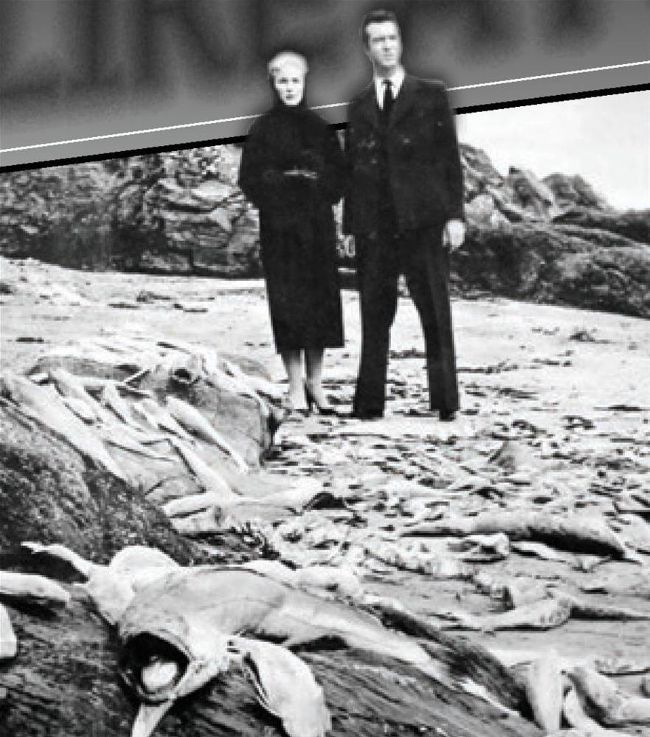
Leigh Madison and John Turner in Behemoth the Sea Monster (1959)
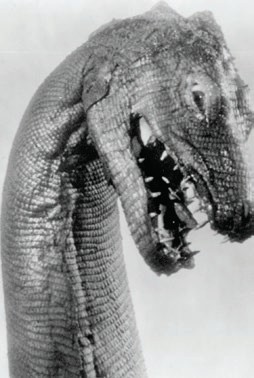
The damaged Live Action head and neck does it’s best to look menacing in the tank before attacking the ferryboat; Leigh Madison and John Turner, with Henri Vidon as a fisherman dying of radiation burns; Gene Evans with a sketch of the Paleosaurus; One of the few split screen shots in the film showing the Behemoth in the same shot as the live actors; the Behemoth on the rampage