ON THE
Incubated in Düsseldorf’s progressive underground scene during the late ’60s, the formative incarnation of KRAFTWERK involved flutes, improvisational jazz rock and LSD. How, then, did these arty hippies transform into music’s most famous robots? With the 50th anniversary of Autobahn this year, we explore the origins of these mechanical marvels with help from former bmates and contemporaries. “Early Kraftwerk was free music, free people,” one founder member tells Nick Hasted. “All our friends together.”
Photo by HEILEMANN/CAMERA PRESS
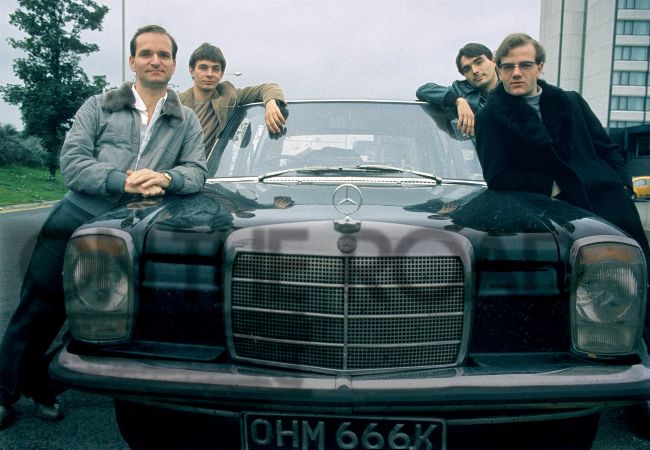
Fahrenfromhome: (l–r)Florian Schneider,Karl Bartos,Wolfgang Flür and Ralf Hütter in London, 1975
KRAFTWERK
ROAD
APRIL 20, 2024, Kunstpalast art museum, Düsseldorf.
Eberhard Kranemann, now 79, is playing explosive free jazz guitar inside a partial recreation of the city’s legendary underground club, Creamcheese.
He is accompanying his younger self, leading his proto-industrial band PISSOFF on a recording made at the original Creamcheese on May 6, 1968. Behind Kranemann, a screen shows footage of the city’s shamanic Fluxus artist Joseph Beuys, deadpan in a fedora and trench coat as he semaphored hand-signals in response to PISSOFF’s set that night, 56 years previously.
A Düsseldorf nexus of visual art and music, inspired by Andy Warhol’s The Dom and named after Zappa’s fictional character Suzy Creemcheese, the club was opened in 1967 by artist Günther Uecker. Televisions, installed along the walls, were permanently switched on – as were many of the clientele. “We smoked a lot of dope and took a lot of LSD there,” says Kranemann. It was a world of revolutionary sound and vision that timid, flute-playing student Florian Schneider-Esleben wished to enter. This, maintains Kranemann, is where Kraftwerk began.
“PISSOFF was anti-music,” Kranemann says. “It was very rough material. Free, free music. Only art students or some people who were against society came at first. It was a protest, a revolution against shit society, shit parents, shit politicians – to destroy everything! Florian liked it very much, and asked me, ‘Can I play with you?’ We had a big gig at the Art Academy,
Düsseldorf, in 1967, with Tangerine Dream and Guru Guru, and Florian played with me in PISSOFF. Then Florian and I met in our homes to make other kinds of music experiments. First only us two played together. Then the next year, Florian met Ralf Hütter…”
Revolution, confrontation, LSD trips… this is all a world away from the incarnation of Kraftwerk who are in residence this month at the Walt Disney Concert Hall in Los Angeles. As Kraftwerk, in various forms, has done for decades, four band members stand in a line behind podiums. Now only Hütter remains from the group’s classic lineup of Wolfgang Flür, Karl Bartos and Schneider – who died in 2020. These concerts offer gleaming digital reproductions of Kraftwerk’s imperial phase, which began 50 years ago with the serene industrial motorik of “Autobahn”.
KRAFTWERK
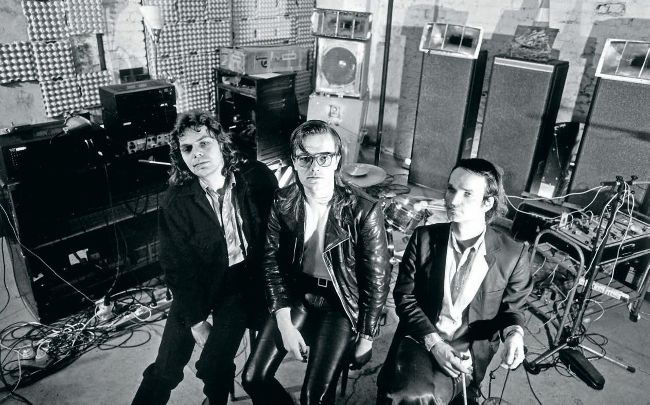
’Werk mates: Emil Schult,Hütterand Schneiderattheir studioinDüsseldorf, February1973
BRIGITTEHELLGOTH/AKG-IMAGES/ULLSTEINBILD
“What I was passionate about in relation to Kraftwerk was their singular determination to stand apart from stereotypical American chord sequences and their wholehearted embrace of a European sensibility,” David Bowie told Uncut in 2001. “This was their very important influence on me. In substance, we were poles apart. Kraftwerk’s percussion sound was produced electronically, rigid in tempo, unmoving. Kraftwerk supported that unyielding machine-like beat with all synthetic sound-generating sources…Theirs was a controlled, robotic, extremely measured series of compositions, almost a parody of minimalism. One had the feeling that Florian and Ralf were completely in charge of their environment, that their compositions were well prepared and honed before entering the studio.”