MANGROVES
THE FRONTIER FORESTS
Delve into the muddy, mysterious world of mangroves, discover the extraordinary life they support, how they manage to thrive where sea meets land and why we urgently need to protect them…
Words: William Gray
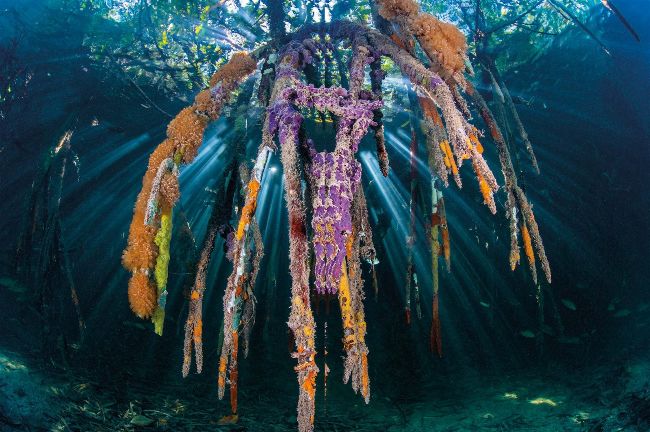
Colourful sponges, sea squirts, anemones and bryozoans encrust the arching roots of red mangrove trees throughout the Caribbean
ALEX MUSTARD/
NATUREPL.COM Mangrove forests are one of nature’s frontline sea defences; self-building, self-repairing and solar-powered, they do the job for nothing and provide a home for a myriad of creatures – from sponges to sharks, fish to frigatebirds. Yet worldwide, we’ve already lost 20 per cent of our mangrove ecosystems due to coastal development. According to UNESCO, these frontier forests are disappearing three to five times faster than overall global forest losses, with serious ecological and socio-economic impacts.
As well as protecting low-lying islands and vulnerable coastlines against storm surges, tsunamis, rising sea levels and erosion, their soils are highly effective carbon sinks, sequestering up to five times more carbon from the atmosphere than forests on land.
Mangroves also provide valuable nursery grounds for fish, conchs, lobsters and other crustaceans which, in turn, support coastal fishing communities and contribute to food security. UNEP research has calculated that by underpinning fisheries and buffering coastlines, every hectare of mangrove forest represents an estimated US$33–57,000 per year. Not only that, but protecting a mangrove forest is 1000 times less expensive, per kilometre, than building a seawall.