Simon Says
An interview by CARPology
It’s the battered baseball cap that does it, but it’s also the captivating storytelling of Simon Scott that creates a whiff of Quint from Jaws. Our interviewee is infinitely friendlier, less intense and (spoiler alert!) has yet to be eaten by a fish -despite our best efforts for the photoshoot. The cap, however, is eerily similar, and so is his magnetic personality and passion for fish. Dyslexia has not stopped Simon developing a knack for conveying his thoughts and vast knowledge of carp, with an enthusiasm that makes his stories so enthralling. A former Sparsholt College student and then lecturer, he represents the perfect example of how linking a hobby with learning, can light a spark that’s impossible to put out.
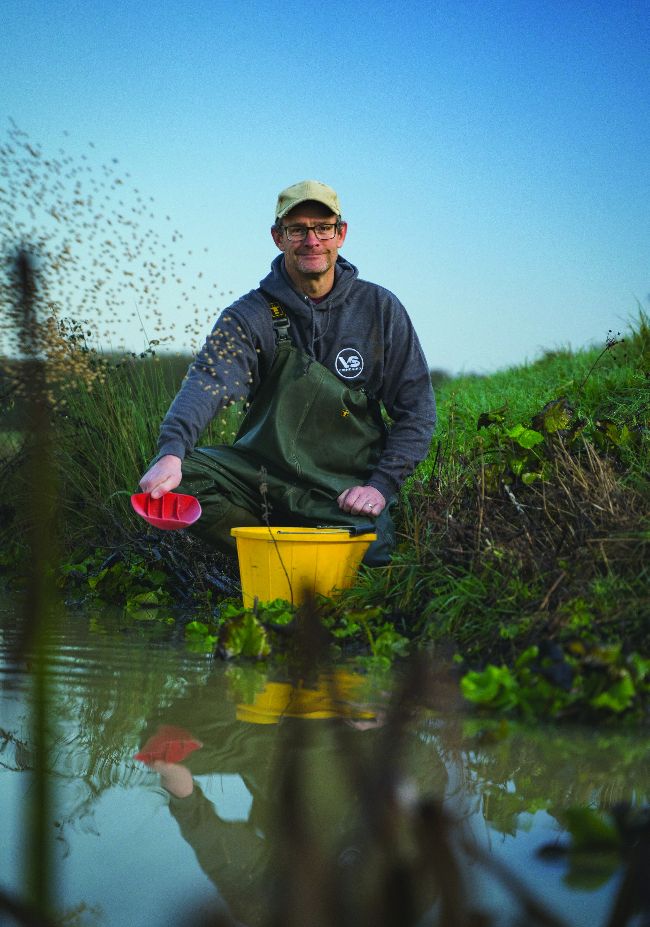
Following on from his insightful diary series, we chat to Simon Scott about his life, his passions, and his time at Sparsholt College
PHOTOGRAPHY CARPOLOGY AND SIMON SCOTT
RIGHT Carp fishing’s go-to guy for fishery and environment questions in the angling media, Simon Scott
1. The Sparsholt Years
CARPOLOGY____ Where did your love of fishing begin?
SIMON SCOTT____ “I guess my love of fishing began at the age of seven. For my seventh birthday, I was given a short, bright-red fishing rod with yellow handle, along with a very small reel, both of which probably came from Woolworths (some might recall the store). I was taken down to the river near where I grew up, and I caught a rudd. From that moment, I was fascinated. Before then, I’d been similarly fascinated by ponds, so as a little tiny kid, I was in or around water all the time.”
C.O.____ How many years have you been fishing?
S.C.____ “A long time… about 43 or 44 years now!”
C.O.____ Is the buzz still the same?
S.C.____ “It’s slightly different. The mystery’s gone a bit, I suppose. I’ve been very, very lucky and have caught some amazing fish. Through my profession, I obviously work with fish a great deal too. I know a lot of other fish farmers, and it’s quite difficult to remain enthusiastic when you’re dealing with fish in respect of your work, but when my fishing head’s on, it’s very much on, and I absolutely love it. I’m still a ‘bite junkie’ and I love it when you sit there with a cup of tea at first light and the rod pulls away; that’s always a great moment.”
C.O.____ Does your love of fishing fluctuate?
S.C.____ “Yeah, I think it does. I deal with thousands upon thousands of fish at the farm, and I also have other interests away from fishing. I’m massively into growing things -trees and vegetables, for instance. I love being outdoors just enjoying the wildlife, so I don’t have to be fishing all the time. It still runs through me, though. Like a stick of rock, there’s an angling thread that never goes away.”
C.O.____ Most people know you through VS Fisheries, your own fishing exploits or your time as a lecturer at Sparsholt College, but what came before Sparsholt?
S.C.____ “When I was at school, as I’ve already mentioned, I was dyslexic. I struggled like mad and the whole concept of lessons was torture. I found things in class extremely difficult, and I absolutely dreaded having to read aloud in an English lesson, but I was lucky in that I had a bit of outdoors contact; I loved that. Whilst doing my A-Levels, I found Sparsholt. It seemed to be absolutely perfect for me… you could go to a college and learn about fish and fish farming! I liked growing stuff from a very early age, so the prospect of going to Sparsholt to learn about fish farming -more than just fishery management -captivated me.
“I was very lucky to get in, and then the fire was well and truly lit. Learning became enjoyable. My struggle with dyslexia became a thing of the past and I just went from strength to strength. I did what would now be regarded as a degree. At the time it was a three-year, Higher National Diploma (HND) course. I was incredibly fortunate in having such brilliant tutors, many of whom I still consider good friends. That set me on the track I’m still on now.
“Then, I went off to do a master’s degree at Plymouth University, where my thesis was all about carp nutrition. My first proper job in the industry was some work at a consultancy company called MacAlister Elliott & Partners. In 1993, the MV Braer oil tanker had run aground off Shetland during a storm. It had split in half and I think about 70,000 tons of crude oil had spilled into the ocean and a dozen fish farms. Pretty much my first job was to assess the compensation claim calculations made by the polluted fish farms -for someone who wasn’t very good at maths, it was quite a responsibility! The fish farmers submitted their claims and I considered whether they were fair or required further investigation. Looking back, it was all quite scary! I went up to Shetland and was treated like royalty, because I would effectively be paying the farmers lots of money, of course -or at least would be recommending the level of payment.
“I then did a bit of fishery management at various locations and met up with Shaun Leonard. ‘Have you seen that we’re looking for someone at Sparsholt?’ he said. The rest is history.”
C.O.____ Was it an easy decision?
S.C.____ “Yeah, it was, because I’d absolutely loved being at Sparsholt as a student and I had huge respect for those in the fishery team there. I think at that point, the fishery section at Sparsholt was in its heyday; it was absolutely the place to go. Shaun has become a friend and I have a lot of respect for him. ‘You’ll be brilliant!’ he suggested. ‘Really?’ I replied. ‘Because of your dyslexia and struggles with classroom stuff, you’ll be able to relate to the students really well,’ he said.”
C.O.____ What year was that?
S.C.____ “That would’ve been 1995 or 1996, I guess.”
C.O.____ And how long did you stay at
Sparsholt?
S.C.____ “I taught there 20 years.”
C.O.____ What were those years like… very heady?
S.C.____ “Yeah, very heady! It was a great time and I joined a brilliant, exceptionally tight-knit team. Being in that gang really was a fantastic period in my life.”
C.O.____ Work hard, play hard?
S.C.____ “Yeah, we worked very, very hard. We were madly enthusiastic for it, but as an example, we used to play ultimate frisbee out in the playing fields every lunchtime. Most of us were massively into physical training and going to the gym. It was a time when you were able to enjoy lunch breaks, because there were no emails to check. Our hour off for
lunch would be 55 minutes of ultimate frisbee, two minutes to eat, two minutes to wipe the sweat off and then a minute to get to the classroom for the next lecture! We also went on some amazing study tours across Europe, so it really was a great time.”
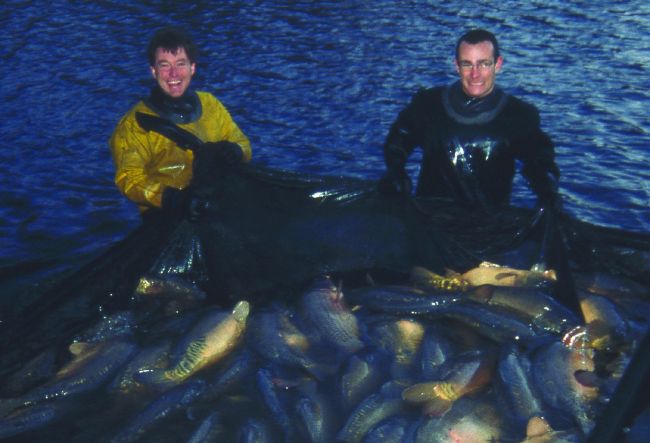
Shaun
Leonard
became
a
great
friend
and
I
have
a
lot
of
respect
for
him.
Here
we
are
with
a
huge
haul
during
one
of
our
many
nettings
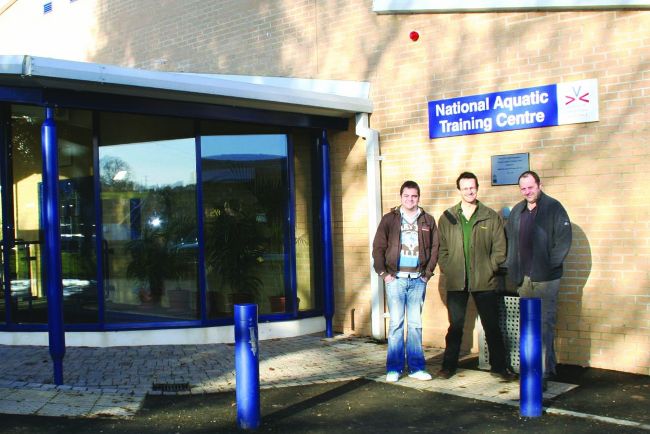
Sparsholt:
I
had
a
great
time
and
I
joined
a
brilliant,
exceptionally
tight-knit
team;
it
really
was
a
fantastic
period
in
my
life…
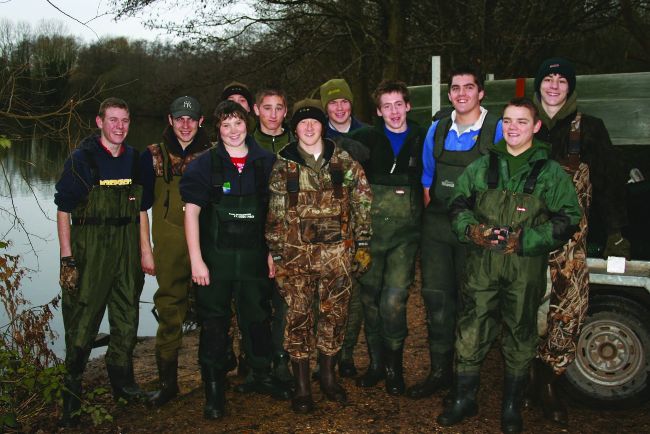
One
of
the
many
nettings
me
and
my
students
carried
out
on
the
Yateley
complex.
Great
memories
C.O.____ You’re now slightly removed from the teaching world, but how have those courses changed? Are there now more around the country, or are they less popular?
S.C.____ “I think the numbers have come down a bit and there are other places doing them, but there’s still a core of really sound guys at Sparsholt. Through my Instagram account, I’m frequently asked, ‘Where can my son/ daughter go to learn about what you do?’ I always reply, ‘Go to Sparsholt.’ I owe that place a great deal.”
C.O.____ There are definitely more day-ticket carp waters about these days…