CHAPTER 3
Particularly Good Particles
John Baker returns with more advice on bait. As he shares more of his expansive knowledge, he looks at particle preparation, gives us his thoughts on flavourings, and offers a word of caution regarding the use of salt…
BY JOHN BAKER
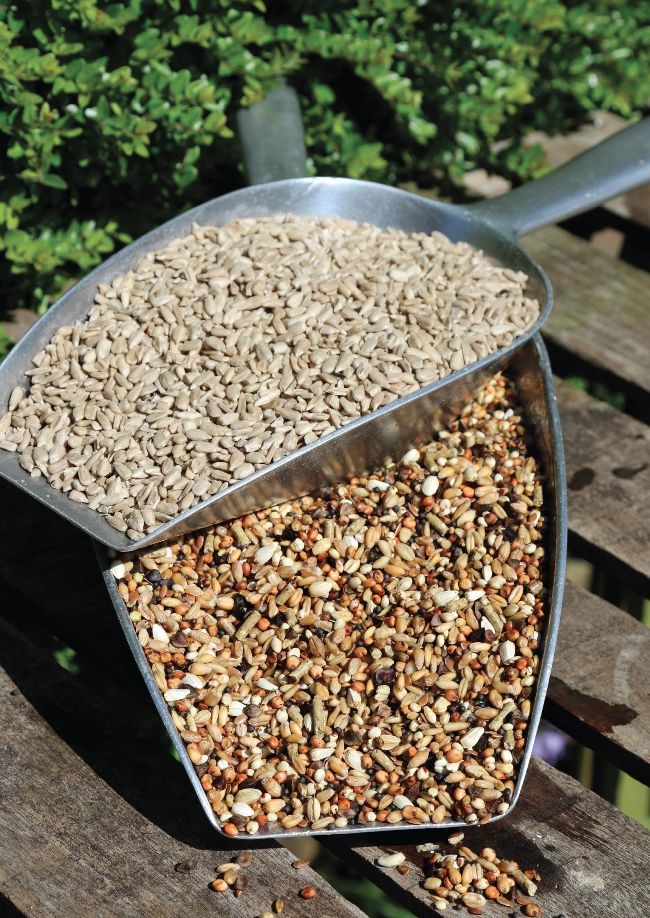
On top: sunflower seeds; on bottom: Haith’s Red Band Pigeon Food
PHOTOGRAPHY JOHN BAKER AND FRIENDS
PARTICLE BAITS come in so many forms, and yet some seeds, beans and nuts tend to fall in and out of popularity. Mass particles were historically used on their own, usually as a single, standalone bait, the forerunner of the seed-bait revolution being hemp, its use initially pioneered by French match anglers, who used it in a toasted form in groundbait. But in recent years, many different sorts of seeds and particles have come to be used in carp groundbait. The tactic of fishing nonmatching hookbaits, such as boilies and pop-ups, or plastic imitation bait, amongst mass beds of particles and seeds is now a common practice. The popularity of using remote-controlled bait boats to deliver mass particles adds to the ease with which this tactic can be employed.
Over the last decade, spodding and Spombing particle baits accurately, and often at long-range, has become the norm. Having said this, I must confess, that I am not so interested in how these types of bait might be deposited into the target zone, but I am very interested in the type and nature of the bait itself. As a bit of a traditionalist, I would struggle to justify ever using a bait boat, and I offer my most sincere apologies if I might have offended those who feel they need to. Whatever your preferred method of getting particles out into the wet stuff, I shall leave the debate on the ethics of the use of bait boats for another day.
As readers might expect, I just happen to be rather particular about the type of particles I use—hence the title of this month’s piece. I am also especially keen to find new ways of making my particle bait a bit different from other anglers’, and this can be achieved in many ways, and with relatively little effort. I will go on to discuss a few of my favourite particles, and how I usually prepare them, and whilst this subject has been covered many times in the past, it will do no harm to go over a few tried-and-tested preparation methods.
I see little point in spoiling the natural attraction of nice, fresh, seeds, nuts, and pulses when the whole point of using them is to create a zone of natural feeding security. I say this because particles, first and foremost, should be considered as an effective alternative to the ubiquitous boilie- style approach we have often come to rely on. Carp may become wary of highly flavoured particles, and so my starting point would be to use them presented as plainly as possible.