atau tanaka
ATAU TANAKA
Atau Tanaka creates electronic music using the movement of his own body, with custom software – and he thinks we should all try it. We catch up with the artist taking the ideas of software control and performance to a completely new level…
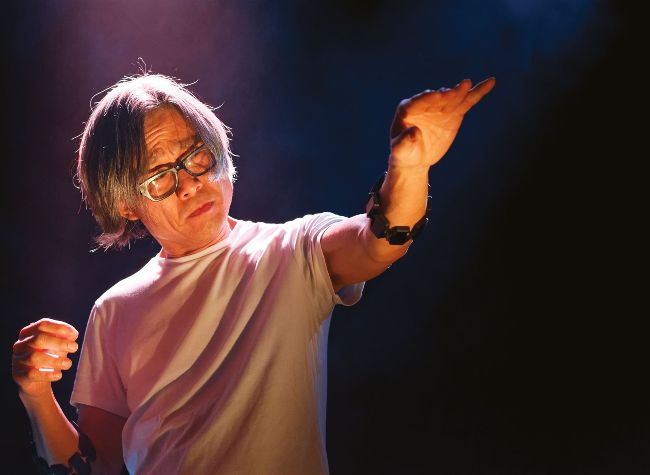
Photo: Martin Delaney
> An electronic music setup covers anything from a simple MIDI keyboard with a laptop and headphones, to a huge modular setup. But none of this applies for Atau Tanaka, a Japanese-American artist who appears to be pulling sounds out of the air through arm movements, hand gestures, and muscle tension. We talked to Atau about his setup, his extensive history with expressive electronic music, and what’s coming next for music technology.
Classical, jazz, electronic…
“My musical education was quite traditional. I started off playing the piano as a child, but I got sick of playing classical music in my late teens,” Tanaka tells us when we ask him to tell us a bit about his musical upbringing.
“I tried to switch to jazz, but I didn’t have the ear for it – so I picked up the electric guitar! In my university days I played in free improv bands – there was a club in NYC called the Knitting Factory, and John Zorn played there, and Fred Frith, and I’d see gigs of theirs, and met them eventually. Then I discovered the electronic music studio at Harvard, where I was doing my university studies, and a composer there, Ivan Tcherepnin, was my mentor. And this was the early ’80s, so we had open reel tape machines, spliced up tape, we had a Buchla 200 synth, a Serge modular, and I got into analogue electronic music.”
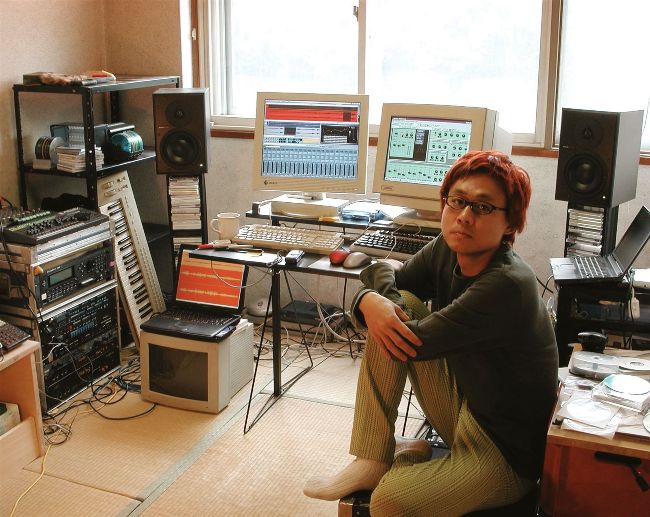
A young Tanaka photographed around -1999
Photo:: Kyoichi-Tsuzuki
Atau was quick to embrace the possibilities of MIDI and digital audio. “In 1984, the Mac 128k came out, and MIDI synths came out. I bought a Roland JX-3P – their first synth with MIDI. And I was always interested in ultimate controllers, you know, I was exploring the early MIDI guitar systems. That search for controllers is a theme right through until today.”
“The laptop enabled me to take it [electronic music] on tour. In the early ’90s, the Apple PowerBook didn’t do audio – it was just MIDI, and Max was MIDI only. It would take MIDI input from Bio Muse – that was the muscle interface. And then I had a rack with a Yamaha TG77, a Korg Wavestation, and Kurzweil K2000, and I was trying to make sounds from those in a way that you couldn’t get from a keyboard input. When the PowerPC chip came out in the mid ’90s, you could do audio on the laptop, and Max took on MSP functions, and that’s when I was able to stop using the rack, because I was carrying it on trains all around Europe on tour.”