MYSTERIES OF THE UNIVERSE
UNLOCKING THE SECRETS OF THE ANTIKYTHERA MECHANISM
Scientists are closer to cracking a complex 2,000-year-old astronomical calculator after decades of painstaking work
Reported by David Crookes
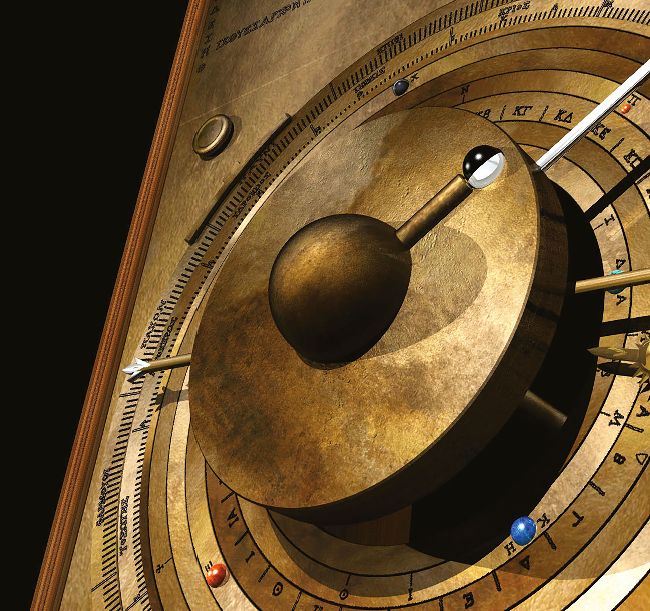
© UCL
In1900, sponge diver Elias Stadiatis was in the waters off the coast of the Greek island of Antikythera when he made a startling discovery. What lay before him appeared to be rotting corpses and horses scattered over the seafloor amid the remains of a Greek shipwreck. After a team of divers were sent to take a look later that year, it didn’t take long to work out what Stadiatis had seen: a treasure trove of bronze and marble statues, some of which dated back to the 4th century BCE. But the divers didn’t know they had also recovered something even more remarkable.
An object roughly the size of a large book was discovered in the depths of the wreck in 1901. The following year, archaeologist Spyridon Stais happened to be looking at the book-sized lump and it began to crumble. As it did so, he could see a corroded piece of bronze embedded with precision gear wheels but most of the technology was obscured by corrosion. while it was simply a curiosity, and put on public display. Although some work was carried out, notably in 1905, by German philologist Albert Rehm, nobody went into great detail for some time. Still, Rehm made some interesting discoveries such as the inscription of the numbers 19, 76 and 223. And he became the first to propose it was an astronomical calculator since those numbers represented Moon-Sun cycles.
WHO BUILT THE ANTIKYTHERA MECHANISM?
No one knows who created the Antikythera mechanism, but many researchers believe Archimedes may have played a part. The ancient Greek mathematician, astronomer and inventor – the man who is said to have leapt out of his bath and run down the street naked shouting “Eureka!” after discovering the principle of buoyancy – lived around the time the device would have been made. One theory is that it was likely made after he died, based on his expertise. “Archimedes died about 212 BCE, when he was killed by a Roman soldier during the siege of Syracuse, and it’s my belief he started the tradition of making these devices,” Freeth says. “There’s a description by the Roman politician Cicero of two machines made by Archimedes that showed the motion of the Sun, Moon and five planets. This is what the Antikythera mechanism does and there is evidence that there were more than one of these things around in antiquity. My belief is that Archimedes started the tradition of making these devices and they were picked up later by other people copying his designs.”