Sie sehen gerade die Germany Version der Website.
Möchten Sie zu Ihrer lokalen Seite wechseln?
16 MIN LESEZEIT

STARGAZER

OBSERVER’S GUIDE TO THE PLANETS

Your guide to getting the best views of the Solar System

VENUS

Being between Earth and the Sun gives Venus – the brightest planet – its famous phases

Being the closest planet to us, it’s no surprise that Venus is such an easy target to find in the sky. However, that doesn’t tell the whole story. Due to its highly reflective atmosphere, Venus is considerably brighter than it should be, only outshone by the Sun and the Moon in the sky. The planet is enveloped in clouds of sweltering carbon dioxide laced with sulphuric acid that trap in a lot of the heat it receives from the Sun. With temperatures often tipping 460 degrees Celsius (860 degrees Fahrenheit), this runaway greenhouse effect makes Venus the hottest planet in the Solar System, even though it doesn’t lie closest to the Sun.

Although not a star itself, Venus has long been known as the ‘morning star’ or ‘evening star’. However, Venus’ unique appearance differs in one striking way from a star – it doesn’t twinkle. Stars twinkle thanks to Earth’s atmosphere. They are so far away from us that we can only ever see them as tiny pinpricks of light. If a pocket of atmospheric dust and gas moves in front of that light, it can temporarily block it out entirely, meaning that from our perspective the stars seem to flicker on and off. Planets, however, are so much closer to us – being in the Solar System – that they actually appear as discs in the sky whose reflected light can never be blocked out entirely.

If you have a pair of binoculars, it’s well worth pointing them towards Venus to see that disc up close. As always with binoculars, setting them up on a photographic tripod will give you a more stable view than the wobbling caused by holding them by hand. Looking at Venus, you should easily make out one of the most famous sights in astronomy: the phases of the second planet from the Sun. As it orbits closer to the Sun than we do, the amount of light Venus reflects towards us changes – in this sense it’s similar to the phases of the Moon. When the planet lies far from the line between the Sun and Earth, we see phases akin to a first quarter and last quarter Moon, with the planet half illuminated. This point, known as greatest elongation, happens twice in Venus’ 225-day orbit.
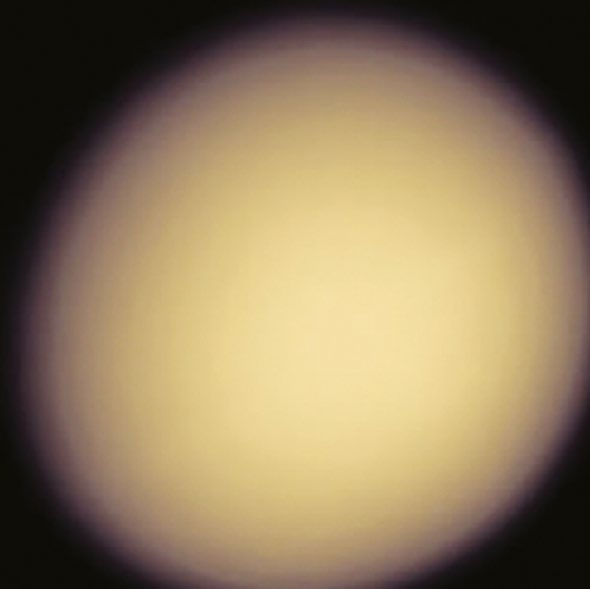
Venus’ phases are evident when observing it
© NASA

“Venus has long been known as the ‘morning star’ or ‘evening star’”

By observing the phases of Venus you will be following in a long line of astronomical greats, most notably Galileo Galilei. The Italian astronomer was the first person to see the changing shapes of Venus in the early 17th century, immediately realising that it vindicated Copernicus’ heliocentric idea that Earth orbited the Sun and not the other way around. Only if both Earth and Venus were circling the Sun, with Venus closer in than us, would we see this effect. That sounded the death knell for Ptolemy’s geocentric idea that Earth was at the centre of the Solar System.

Schalten Sie diesen Artikel und vieles mehr frei mit
Sie können genießen:
Genießen Sie diese Ausgabe in voller Länge
Sofortiger Zugang zu mehr als 600 Titeln
Tausende von früheren Ausgaben
Kein Vertrag und keine Verpflichtung
Versuch für €1.09
JETZT ABONNIEREN
30 Tage Zugang, dann einfach €11,99 / Monat. Jederzeit kündbar. Nur für neue Abonnenten.


Mehr erfahren
Pocketmags Plus
Pocketmags Plus

Dieser Artikel stammt aus...


View Issues
All About Space
Issue 131
ANSICHT IM LAGER

Andere Artikel in dieser Ausgabe


All About Space
WELCOME ISSUE 131
Leslie Kean If you’ve ever wanted to know
LAUNCH PAD
Martian stretch marks
© ESA Scratches and grooves on the Martian
Hubble’s grand design
© ESA/Hubble & NASA A newly released image
First image of our galaxy’s black hole
© ESO The Event Horizon Telescope has captured
Humanity will go to Mars ‘in this decade’, SpaceX president predicts
A crewed Mars mission could happen sooner than
Black hole might have executed a magnetic ‘flip’
Artist’s depiction of a supermassive black hole before
Start-up sells 1,000 tickets for balloon trips near the edge of space
The World View space capsule ascending into Earth’s
Asteroid treasure trove found in old Hubble data
In a new study, astronomers and amateur scientists
THE UNIVERSE EXPLAINED
Meet the people behind the experiments searching for answers to how our universe began
FUTURE TECH
EUROPA DRILL
What lies under the Jovian moon’s ice? A mission is needed to probe its secrets
INTERVIEW
“I really didn’t know what to expect”
Ferguson reveals his regret at the retirement of NASA’s iconic Space Shuttle, but tells us how excited he was to be working on the next generation of spacecraft at Boeing
FOCUS ON
WATER ON MARS
China’s rover suggests the liquid may have been on Mars much more recently than scientists thought
THE LARGE HADRON COLLIDER COULD SOLVE
What problems could the world’s largest and most powerful particle accelerator unlock?
EARLIEST AURORA DOCUMENTED IN ANCIENT CHINESE TEXT
It’s about 300 years older than the previous record holder
UNLOCKING THE SECRETS OF THE ANTIKYTHERA MECHANISM
Scientists are closer to cracking a complex 2,000-year-old astronomical calculator after decades of painstaking work
HUBBLE SPOTS STAR THAT SURVIVED A VIOLENT EXPLOSION
NASA’s most iconic space telescope has uncovered an object that survived the violent death of its companion
INSIDE AREA 51
The region is synonymous with tales of UFOs, government cover-ups and testing alien technology
PLANET PROFILE
CHINA IS ON THE HUNT FOR EARTH 2.0 WITH PROPOSED SPACE TELESCOPE
If approved, the mission will launch in 2026
JUPITER
The largest planet has a lot to tell us, and Juno is on the case
INSTANT EXPERT
HOW ARE AURORAE FORMED ON OTHER PLANETS?
The northern and southern lights occur when the solar wind affects our atmosphere, but this can happen on other worlds too
How hot does it get between galaxies in a cluster?
Many galaxies in the universe live alongside others,
Is our galaxy orbiting around an object in the universe?
Yes, the Milky Way does orbit something, and
STARGAZER
WHAT’S IN THE SKY?
What to look out for during this observing period
PLANETARIUM
29 JUNE 2022
THIS MONTH’S PLANETS
If you’re a planetary observer, you’re in for a treat from June through to July
TAURUS-LITTROW VALLEY
Visit the historic landing site of the final Apollo mission
NAKED EYE AND BINOCULAR TARGETS
The summer Milky Way offers a plethora of targets
SUMMER’S DAZZLING DEEP-SKY TREATS
On light summer nights, glittering star clusters, a dead star and a beautiful double star await
THE NORTHERN HEMISPHERE
A selection of targets for whatever observing kit you have in your arsenal
ASTROSHOTS OF THE MONTH
Rho Ophiuchi BASUDEB CHAKRABARTI Location: Oria, Spain Telescope:
LEGO NASA SPACE SHUTTLE DISCOVERY
A big kit with big fun, this set is an enjoyable build that’s truly out of this world
FATHER’S DAY GIFT GUIDE
The latest books, apps, software, tech and accessories for space and astronomy fans alike
JOHANNES KEPLER
The astronomer who redefined our understanding of the Solar System
Chat
X
Pocketmags Unterstützung