Sie sehen gerade die Germany Version der Website.
Möchten Sie zu Ihrer lokalen Seite wechseln?
General Interest


Free Sample Issue
Testen Sie eine Gratisprobe von Astronomy Now
Testen Sie eine Gratisprobe von

Astronomy Now Magazine

12 Ausgaben pro Jahr   |  English
0 Bewertungen   •  English   •   General Interest (Astronomy)
From €4,50 pro Ausgabe
The wonders of the Universe explained for everyone to understand.
read more read less
Astronomy Now Preview Pages Astronomy Now Preview Pages Astronomy Now Preview Pages Astronomy Now Preview Pages Astronomy Now Preview Pages Astronomy Now Preview Pages Astronomy Now Preview Pages Astronomy Now Preview Pages

Astronomy Now

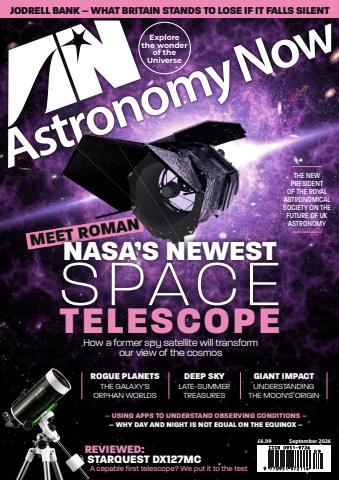
September 2026 The September issue of Astronomy Now looks to the future of astronomy, beginning with NASA’s next great space observatory. The Nancy Grace Roman Space Telescope will survey the Universe with Hubble-like sharpness across a field of view around 100 times larger, opening a new window on dark energy, exoplanets and the changing sky. We meet Roman and explore why astronomers expect it to become a remarkable discovery machine. Closer to home, we ask what Britain stands to lose if Jodrell Bank’s e-MERLIN radio telescope network falls silent, and talk to the new President of the Royal Astronomical Society about the opportunities and challenges facing UK astronomy. Elsewhere, we venture into the Galaxy in search of rogue planets, mysterious worlds that wander through space without a star and may even outnumber the stars themselves. We also rediscover the forgotten constellations that once populated the night sky, and ask what the latest evidence can tell us about one of astronomy’s oldest mysteries: how the Moon was born. For observers, September brings some of the finest deep-sky sights of late summer, while our Night Sky section provides everything you need to make the most of the month ahead. We also explore how apps can help you understand observing conditions and explain why day and night are not actually equal on the equinox. Plus, we put the Starquest DX127MC Maksutov-Cassegrain through its paces to find out whether it makes a capable first telescope, alongside our regular coverage of astronomy news, equipment, imaging, books and the observing community. Order your copy of the September 2026 issue of Astronomy Now today.


FORMAT AUSWÄHLEN:
Sofortiger Zugang

Verfügbare digitale Angebote:

Digitale Einzelausgabe September 2026
 
7,99 / issue
Jährlich Digitales Abonnement €53,99 jährlich abgerechnet
SPAREN
44%
€4,50 / Ausgabe
Monatlich Digitales Abonnement €5,99 monatlich abgerechnet
SPAREN
25%
€5,99 / Ausgabe
Verfügbar mit
Pocketmags Plus
Unbegrenztes Leseabonnement
 
€1.09
Erhalten Sie unbegrenzten Zugang zu Astronomy Now und mehr als 600 weitere großartige Titel. Verlängert um €11,99 / Monat nach 30 Tagen. Jederzeit kündbar. Weitere Informationen
Die Ersparnisse werden auf der Grundlage eines vergleichbaren Kaufs von Einzelausgaben über einen annualisierten Abonnementzeitraum berechnet und können von den angegebenen Beträgen abweichen. Die Berechnungen dienen nur zu Illustrationszwecken. Digitale Abonnements beinhalten die letzte Ausgabe und alle regulären Ausgaben, die während Ihres Abonnements erscheinen, sofern nicht anders angegeben. Das von Ihnen gewählte Abonnement verlängert sich automatisch, wenn es nicht bis zu 24 Stunden vor Ablauf des laufenden Abonnements im Bereich Mein Konto gekündigt wird.

Astronomy Now issue September 2026

Astronomy Now  |  September 2026  


The September issue of Astronomy Now looks to the future of astronomy, beginning with NASA’s next great space observatory. The Nancy Grace Roman Space Telescope will survey the Universe with Hubble-like sharpness across a field of view around 100 times larger, opening a new window on dark energy, exoplanets and the changing sky. We meet Roman and explore why astronomers expect it to become a remarkable discovery machine.

Closer to home, we ask what Britain stands to lose if Jodrell Bank’s e-MERLIN radio telescope network falls silent, and talk to the new President of the Royal Astronomical Society about the opportunities and challenges facing UK astronomy.

Elsewhere, we venture into the Galaxy in search of rogue planets, mysterious worlds that wander through space without a star and may even outnumber the stars themselves. We also rediscover the forgotten constellations that once populated the night sky, and ask what the latest evidence can tell us about one of astronomy’s oldest mysteries: how the Moon was born.

For observers, September brings some of the finest deep-sky sights of late summer, while our Night Sky section provides everything you need to make the most of the month ahead. We also explore how apps can help you understand observing conditions and explain why day and night are not actually equal on the equinox.

Plus, we put the Starquest DX127MC Maksutov-Cassegrain through its paces to find out whether it makes a capable first telescope, alongside our regular coverage of astronomy news, equipment, imaging, books and the observing community.

Order your copy of the September 2026 issue of Astronomy Now today.
mehr lesen weniger lesen
The wonders of the Universe explained for everyone to understand.

Als Abonnent erhalten Sie die folgenden Vorteile:


•  Ein Rabatt auf den UVP Ihrer Zeitschrift
•  Neue Ausgaben werden am Erscheinungstag auf Ihr Gerät geliefert
•  Sie werden keine Ausgabe verpassen
•  Sie sind vor Preiserhöhungen geschützt, die später im Jahr eintreten können

Sie erhalten 12 Ausgaben während eines 1-Jahres Astronomy Now Zeitschriftenabonnement.

Hinweis: Die digitalen Ausgaben enthalten nicht die in den gedruckten Exemplaren enthaltenen Umschlagseiten oder Beilagen.

Ihr Kauf hier bei Pocketmags.com kann auf jeder der folgenden Plattformen gelesen werden.


Sie können hier auf der Website lesen oder die App für Ihre Plattform herunterladen. Vergessen Sie nicht, sich mit Ihrem Pocketmags-Benutzernamen und Passwort anzumelden.

Apple Pocketmags Online Pocketmags Google Pocketmags
Die Pocketmags-App läuft auf allen iPad- und iPhone-Geräten mit iOS 15.6 oder höher, Android 8.0 oder höher sowie Amazon Fire-Tablets ab dem Jahr 2018. Besitzer älterer Fire-Modelle können jedoch den Amazon Appstore direkt auf ihrem Gerät aufrufen, um die Kompatibilität zu prüfen. Für iOS-Nutzer empfehlen wir die Verwendung eines Geräts, das die neueste iOS-Version ausführen kann, um eine optimale Leistung und Stabilität zu gewährleisten. Ältere Hardware mit geringerer Prozessorleistung und weniger RAM kann aufgrund von Speicherbegrenzungen des Geräts zu einer langsameren Seitenanzeige oder gelegentlichen Stabilitätsproblemen führen. Alternativ funktioniert unser Web-Reader mit jedem modernen, HTML5-kompatiblen Browser, wobei wir für die beste Nutzung auf PC und Mac Chrome oder Firefox empfehlen.
N/A
Basierend auf 0 Kundenrezensionen
5
0
4
0
3
0
2
0
1
0
Rezensionen ansehen

Artikel in dieser Ausgabe


Im Folgenden finden Sie eine Auswahl von Artikeln aus Astronomy Now September 2026.

Free Sample Issue
Testen Sie eine Gratisprobe von Astronomy Now
Chat
X
Pocketmags Unterstützung