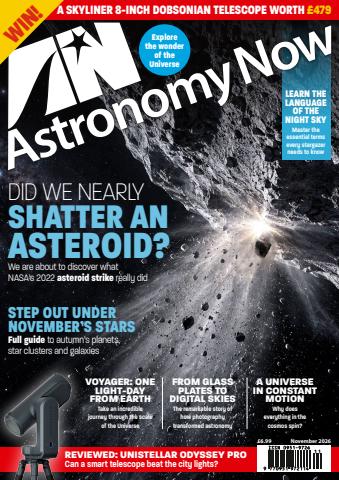
Astronomy Now | November 2026
The November issue of Astronomy Now takes a deep dive into the world of planetary defence. NASA’s spectacular collision with asteroid Dimorphos in 2022 was certainly a milestone in demonstrating how to protect Earth but did the impact do more than simply knock the asteroid off course?
Astronomy Now‘s editor Stuart Clark investigates the subsequent observations that suggest we could have done a lot more damage than anticipated and how the arrival of ESA’s Hera mission this month will finally reveal the truth.
Meanwhile, the Voyager 1 spacecraft is approaching an extraordinary milestone. Launched in 1977, the veteran piece of space hardware is about to reach a distance of one light-day from Earth. Just how far away is that? Jane Green takes us on a fascinating journey through the scale of the Universe, putting Voyager’s remarkable achievement into cosmic perspective.
With the longer nights upon us, there has never been a better time to explore the heavens. The wonders of the night sky are free to all of us but what exactly do astronomers mean when they talk about magnitudes, conjunctions and deep-sky objects? Stuart Atkinson explains the language of the night sky in an accessible guide to the essential terms every stargazer should know.
Step back in time, as we also take a journey through the history of astrophotography, from the earliest astronomical photographs on glass plates to today’s extraordinary digital images. Along the way, we explore some of the treasures held by the Royal Astronomical Society and discover a new competition celebrating the achievements of amateur astrophotographers.
And why does everything in the Universe seem to rotate? From planets and stars to galaxies and galaxy clusters, spinning is everywhere in the cosmos. Colin Stuart investigates what sets the Universe turning and tackles an even bigger question: could the entire Universe itself be rotating?
Plus, there is plenty for observers and astrophotographers to enjoy.
mehr lesen
weniger lesen
Als Abonnent erhalten Sie die folgenden Vorteile:
• Ein Rabatt auf den UVP Ihrer Zeitschrift
• Neue Ausgaben werden am Erscheinungstag auf Ihr Gerät geliefert
• Sie werden keine Ausgabe verpassen
• Sie sind vor Preiserhöhungen geschützt, die später im Jahr eintreten können
Sie erhalten 12 Ausgaben während eines 1-Jahres Astronomy Now Zeitschriftenabonnement.
Hinweis: Die digitalen Ausgaben enthalten nicht die in den gedruckten Exemplaren enthaltenen Umschlagseiten oder Beilagen.
Artikel in dieser Ausgabe
Im Folgenden finden Sie eine Auswahl von Artikeln aus Astronomy Now November 2026.