TROUBLE MAKER
FOR FOUR DECADES, PEDRO ALMODÓVAR HAS BEEN MAKING CONSISTENTLY RIOTOUS, UNPREDICTABLE CINEMA, AND HIS UPCOMING PARALLEL MOTHERS IS NO EXCEPTION. AS HE TELLS US, HE DOESN’T KNOW ANY OTHER WAY
WORDS STEVE ROSE
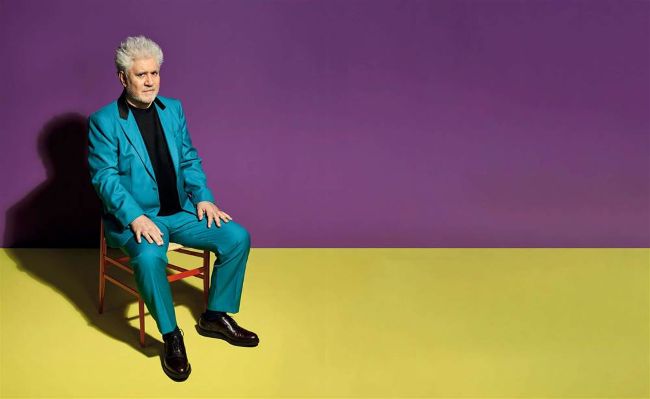
PORTRAITS NICO BUSTOS
IN A CRUCIAL SCENE IN PEDRO ALMODÓVAR’S Parallel Mothers, a two-year-old girl looks into a freshly excavated mass grave from the Spanish Civil War. Her enigmatic gaze encapsulates the movie’s themes in one image: the future confronting the past, trauma passed on down generations. But Almodóvar very nearly didn’t get the shot he wanted. When they began shooting the movie a year earlier, he explains, the child actor was just a baby, “but by the end she had matured into a two-year-old toddler who had her own personality, and shooting was just not part of what she wanted to do that day.” She would not stand still or stop screaming, he recalls. So how did he get the shot? “One of the assistant directors went into the grave and lay down in a corpse’s position. She had been pregnant, and she’d lost her baby. And she began singing lullabies, lullabies she had prepared for her own baby, and the little girl became transfixed. That’s why she’s got that incredible gaze. And we were able to capture that moment.”
Almodóvar has been gazing into the past a fair amount in recent years. Parallel Mothers follows his hugely acclaimed Pain And Glory, in which a renowned Spanish filmmaker of a certain age (played by his regular alter-ego Antonio Banderas) reflects on his life, his career, and his mortality. You can gauge how autobiographical it was by the fact that Banderas’ apartment in the film is an exact replica of Almodóvar’s own.
Almodóvar has been a fixture of cinema for so long, it is easy to take him for granted. In the past 40 years, by his own tally, he has made “22 and-a-half films”. Few living directors have been as prolific, as consistent or as accomplished. Even fewer have an imprint as distinctive as his. Giveaways you’re watching an Almodóvar film might include: bright, clashing colours, sumptuous interiors, irresistible passions, fluid sexualities and gender identities, long-held secrets, kitchens, musical interludes, movie references, wildly improbable plots that somehow make sense, and a tone that hovers somewhere between melodrama, thriller and comedy without really settling on any. Despite his unmistakable signature, Almodóvar still comes up with something fresh every time. In fact, he seems to be getting better with age. How does he do it?