THIS BELONGS TO US!
Richard C. Hoffmann and Alasdair Ross conclude their exploration of tensions between the royal burgh of Stirling and the canons of Cambuskenneth abbey over which one of them had premier right to fish salmon on the river Forth
Richard C. Hoffmann and Alasdair Ross
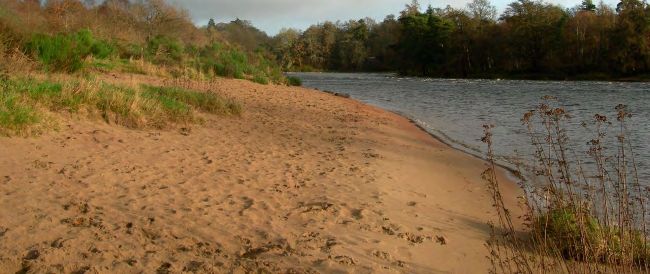
the beach site at Campsie where the nets were pulled
Competition between the royal burgh of Stirling and the augustinian abbey of Cambuskenneth: Part 2
Scotland’s medieval salmon fisheries Like most deeds to property, royal and ecclesiastical charters present salmon, or more accurately, the fishings of salmon, as legal constructs and only most rarely and obscurely as economic activities exploiting natural organisms. This common feature always limits the usefulness of medieval charters and, as allocating ownership rights ceased to be a primary concern of royal governments, diminishes the value of these sources for environmental history. By and large the charters offer sparse operational particulars of the piscaturae they allocate. Besides generic ‘nets’, they identify what are technically beach seines and weirs, two quite distinctive means of capturing fish. The former, a long net with one end anchored to shore, while the other is taken into the water by a coble to surround a (presumed) concentration of fish and then the resultant bag of netting pulled to shore with the catch, are initially to be inferred from repeated charter references to the tractum retis (draw of a net).
Confirmation of this technology comes only from the detailed local records of estate management which everywhere ground historical study of an operating agrarian economy and ecosystem. But from late medieval Scotland only one even fragmentary such set of records has survived. Systematic consideration of this capture technique, its locations and operation must rest on the account books of Coupar Angus, a now utterly destroyed Cistercian monastery with almost exclusively salmon fisheries on the river Tay, its tributaries Isla, Ericht and Dean, and elsewhere on the North Esk, Clyde and Deveron.
Most important was the abbey’s fishery located furthest downriver at Campsie, where natural features still illuminate how local knowledge and experience undergirded capture techniques and ensuing socioeconomic relationships. Campsie is the most richly documented of the Coupar fisheries, but only from the mid-15th century, when each of its probably two or perhaps even more fishing sites or facilities was being let out on mostly five-year terms to groups of fishers. Mid-late 15th-century rental agreements seem to identify at least two separate salmon fishings at Campsie, one for which the tenants supplied all the equipment, including the boat, and another for which the abbey provided the boat. Use of cobles already implies some kind of net or seine fishery. This is confirmed in a stipulation from 1508 of a net 33 fathoms (about 57-66m) long and tapering from four fathoms at the centre to three-and-a-half (from seven or eight to a bit more than six metres) at the outer ends. Elsewhere in Europe the gently sloping shore needed for such beach seines were commonly designated, even possessed, as fishing sites. Both Campsie and the Forth fishings at Craigforth still possess such sandy beaches.
Technically speaking, seine nets call for considerable labour on the part of the fishers but little fixed investment; weir fisheries are more capital-intensive modifications of the environment, some of which survive or have left traces into the present. While Scottish antiquaries and archaeologists have attended to foreshore and estuarine traps meant to strand fish in tidewater, those erected to trap salmon in fast-flowing rivers could be less durable and remain less well-known. Fixed structures of wood and stone extended into or across the river to guide upstream migrants into a channel where they were held or dipped out. The vernacular Scots term cruive and related Latin crova or croha, from a Celtic root for ‘enclosure’, came to specify the wicker boxes, cages or ‘coops’ whence the fish could not escape, while the barrier or fence itself is a ‘yair’. Pools formed below and above the actual structure also concentrated fish for netting.