GUESS THE MEDIEVAL INSTRUMENT
Do you know your timekeepers from navigation devices?
WORDS AILSA HARVEY
DID YOU KNOW?
Watches measured to the quarter hour until minutes were introduced in 1577
TIMEPIECES
ATIME BEFORE CLOCKS
1 An easy one to start with:
these devices were a natural way of telling time, with
the movements of the Sun throughout the day casting shadows on different parts of the equipment. Their use can be traced back to ancient Egypt, and they were commonplace on church walls across the UK during medieval times. At the centre of its circular plate was a protruding style, called a gnomon. This is what blocked the sunlight to cast a shadow. Some of the earlier versions had marked lines dividing a curved plate into 12 segments. This signified the 12 hours of the day. The line that the point of the shadow reached indicated the hour of the day. However, because days were shorter in winter and longer in the summer, hours were different periods of time based on the season. They were called ‘seasonal hours’. Islamic scientists invented more accurate instruments that maintained equal hours throughout the year.
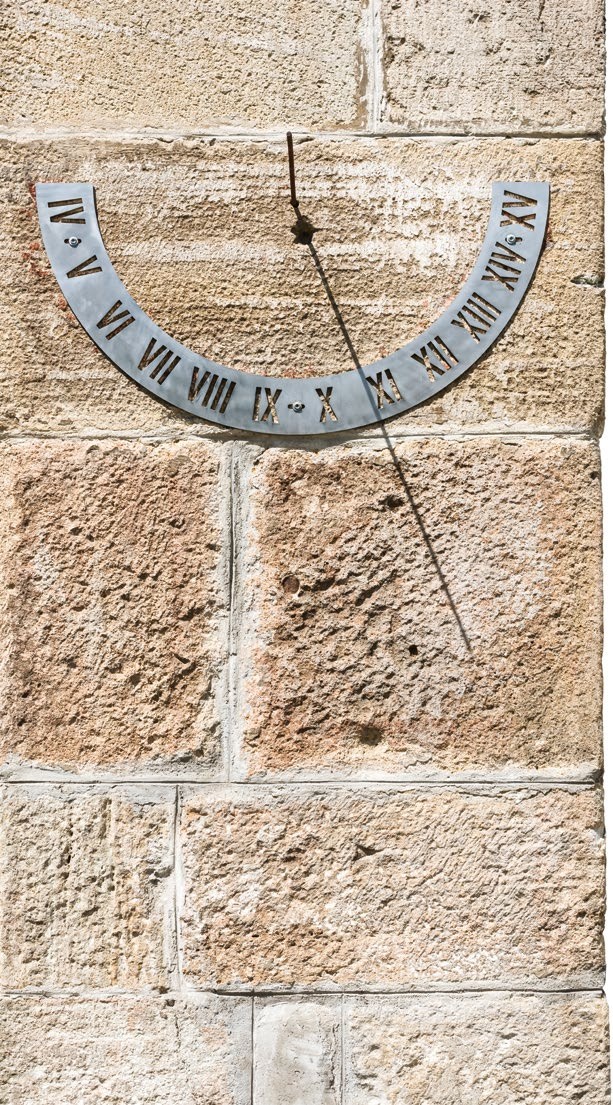
These instruments were often built vertically on south-facing walls
Is this a…?
A. Sundial
B. Water clock
C. Wristwatch
ASTRONOMY
UNIVERSE DEPICTION
3 This instrument represented the
observable universe of medieval times. The centre point depicted the user of the
device. The line across the middle represented the horizon, with the half of the instrument that contains most of the inner circle representing everything above the user and the other half everything below the horizon and out of sight. Each of the shapes pointing into the centre indicated a specific star, together forming a map of the night sky. There were around 1,000 different ways to use this instrument, from establishing the direction of Mecca for Muslim prayers to telling the time.