INTEGRATED TRANSPORT
Pie in the sky?
Many of the major railway companies also operated connecting bus, ferry and ship services – but the 1930s saw the ‘Big Four’ add airline routes to their networks, as Mike Jones describes.
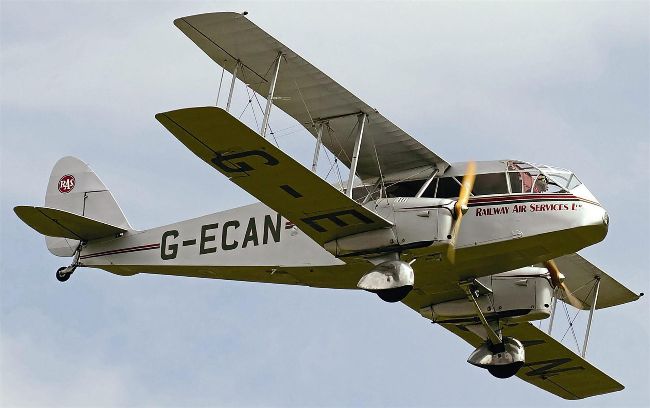
This twin-engined de Havilland DH84 Dragon was actually built in Australia for the RAAF in 1943, but later converted to civilian standard. After it was imported to the UK, it was given this retro 1930s look as Railway Air Services G-ECAN and pictured flying over Duxford (Cambridgeshire) on July 9, 2011.
TONY HISGETT (CC BY 2.0)
THE 1920s had seen railways lose passenger and freight traffic to road operators as the reliability and quality of vehicles improved, so active steps were taken at the end of the decade to ensure there was no repeat in the emerging airline industry, where a step-up in aircraft design brought the prospect of a new source of competition.
Thus the ‘Big Four’ railway companies sought Parliamentary authority to provide air services, which was granted on May 10, 1929 for operation within the boundaries of the rail network provided by the GWR, LMS, LNER and Southern Railway – including Northern Ireland and destinations served by steamer services. The four companies were also permitted to establish routes as far as longitude 20 degrees east, which provided scope for services to the greater part of Europe.
Until that time, a number of commercial flights had been provided by small scale operators that were seasonal in nature and provided services over short sea routes and estuaries. But the aircraft were generally unsuitable and there were no airports as such or navigation aids, which resulted in the Air Ministry asking railway companies to paint station names on the roof of canopies to aid the pilots of early services.
Early operators
Croydon was established as the London Customs Airport in 1920 and Daimler Airway – asubsidiary of the Birmingham Small Arms Company – started a Government-backed service between London and Paris in 1922. Government subsidy was also offered to provide a service between Southampton and the Channel Islands, which commenced in August 1923 by British Marine Air Navigation Co Ltd, a joint venture between Supermarine and Southern Railway (as owners of Southampton Docks).
The services were not operated on a regular basis, and were not economic because only a few passengers could be carried. But a game changer occurred in 1932 when the de Havilland aircraft company offered two new designs, including the DH84 Dragon.
Imperial Airways – formed on March 31, 1924 by the merger of Daimler Airway, British Marine Air Navigation, Handley Page Transport and Instone Air Line (and which can be seen as the predecessor of BOAC and British Airways) – entered into an agreement with the GWR in 1933 to provide an aircraft, crew and supporting engineers to operate a route between Cardiff and Plymouth during the summer season. The aircraft provided was a Westland Wessex, which could carry up to eight passengers at a speed of 90mph.
The service commenced in April that year to Roborough aerodrome in Plymouth, but on the way it also landed at Haldon, where there were connecting buses owned by the railway company to nearby Newton Abbott, Torquay, and Teignmouth.