Chloe Dewe Mathews
This photographer’s latest book reveals a new side to the Thames. Niall Hampton dives in
INTERVIEW
Chloe Dewe Mathews
Photographic artist and filmmaker
Dewe Mathews studied fine art at Camberwell College of Arts and the University of Oxford, and dedicated herself to photography after working in the feature film industry.
Having exhibited at the Tate Modern, the Irish Museum of Modern Art and Dresden’s Staatliche Kunstsammlungen, Dewe Mathews’ work is internationally recognised, and she has been widely published in The Guardian, The New Yorker, Le Monde and the Financial Times.
Dewe Mathews’s books include Caspian: the Elements and In Search of Frankenstein.
She is the recipient of the Robert Gardner Fellowship in Photography from Harvard University’s Peabody Museum of Archaeology & Ethnology, and her work is held in public collections such as the British Council Art Collection, the National Galleries of Scotland and the Irish State Art Collection.
www.chloedewe mathews.com
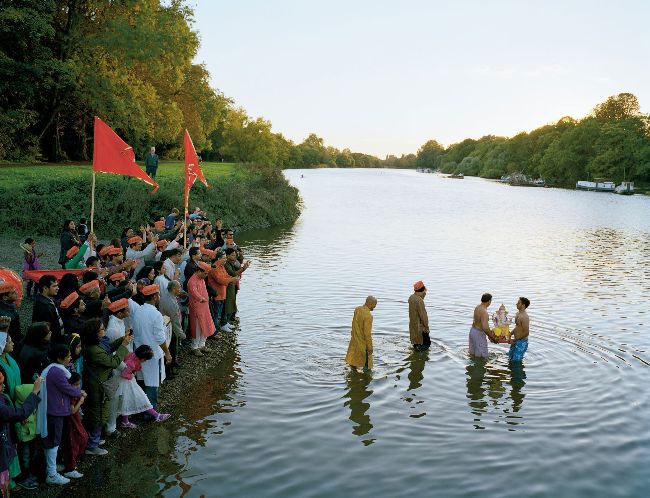
Ganesh Visarjan, Richmond, 2015.
© 2021 Chloe Dewe Mathews; courtesy Loose Joints
You could say that a river runs through the latest book by the photographer Chloe Dewe Mathews – in more ways than one. Thames Log is a series of images made by Dewe Mathews between 2011 and 2016 – images that are sequenced in book form in a very interesting way. The viewer’s journey starts at the head of the River Thames near Kemble in Gloucestershire and ends at the Thames estuary, where the river flows into the North Sea. But the photographs flow through the volume by going against the normal conventions of book form – some images bleed off the edge of the page, with the rest of it continuing on the following page. It’s a clever technique and mimics the flow of the river itself, from source to sea. Yet it doesn’t impact on being able to enjoy the photographs, as the images split over two pages are used to link the main photos.
Thames Log is Dewe Mathews’ fourth book, and follows Caspian: the Elements. But whereas that book examines the relationship between humans and natural resources on the shores of the Caspian Sea between Europe and Asia, Thames Log uses a river to examine how humans relate to the landscape, and the part that rituals – religious and otherwise – continue to play in this relationship.