REVIEWS
Canon EOS R7
Canon’s flagship APS-C format mirrorless camera is aimed at experienced enthusiast photographers.Angela Nicholson takes a look at what it has to offer
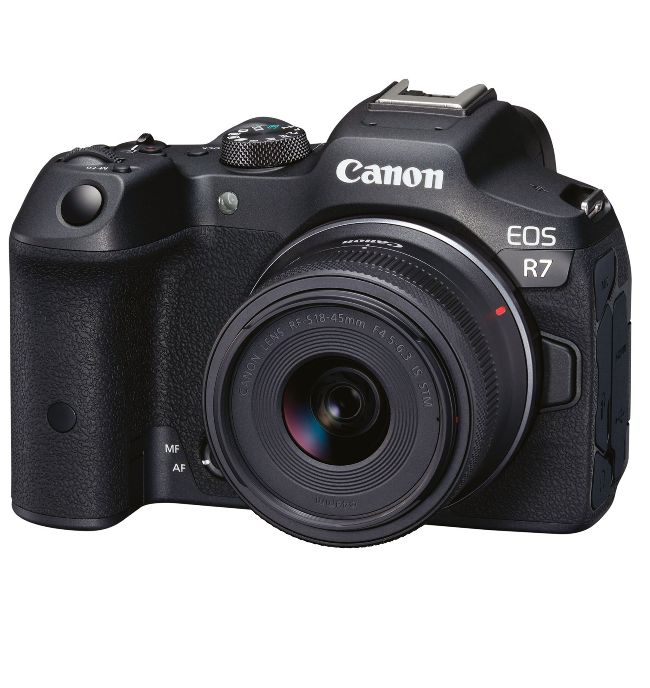
Smaller and lighter The R7 is smaller and lighter than the Canon 90D but has the same degree of weather-sealing
Price: £1,350/$1,499
After many rumours and much anticipation, Canon has introduced the EOS R7 and R10, two mirrorless cameras with the RF mount and APS-C format sensors. The R7 is the more advanced camera of the two models and it has been designed with experienced enthusiast photographers in mind, particularly those with an interest in wildlife photography.
Its APS-C format sensor has 32.5 million effective pixels and is similar to the sensor in the Canon 90D and M6 Mark II but with updated micro lenses and wiring to improve the performance. It’s also coupled with Canon’s new Digic X processing engine and this enables a native sensitivity range of ISO 100-32,000 with expansion settings up to ISO 51,200. There’s also an impressive maximum continuous shooting rate of 15fps (frames per second) for up to 224 JPEGs or 51 RAW files when the mechanical shutter is in use or 30fps for 126 JPEGs or 42 RAW files when the electronic shutter is employed.
The R7’s sensor has Canon’s Dual Pixel CMOS AF II technology, which means that every pixel can play a role in the phase- detection focusing. There’s also intelligent subject detection and tracking, that uses deep-learning algorithms to enable the R7 to detect and focus on people, animals (cats, dogs and birds) and vehicles. It can even use hierarchical detection and prioritise the eyes (provided eye-detection is enabled in the menu) then heads followed by bodies when detecting humans or animals. It’s a useful feature for pet, wildlife and portrait photography. Meanwhile, the vehicle detection is handy when shooting motorsports, and activating the ‘Spot detection’ sets the camera to focus on the driver, if they are visible.