BORN THIS WAY
INTERSEX PIONEERS SPEAK TO JANE CZYZSELSKA ABOUT LIVING IN A WORLD THAT DOESN’T RECOGNISE THEM
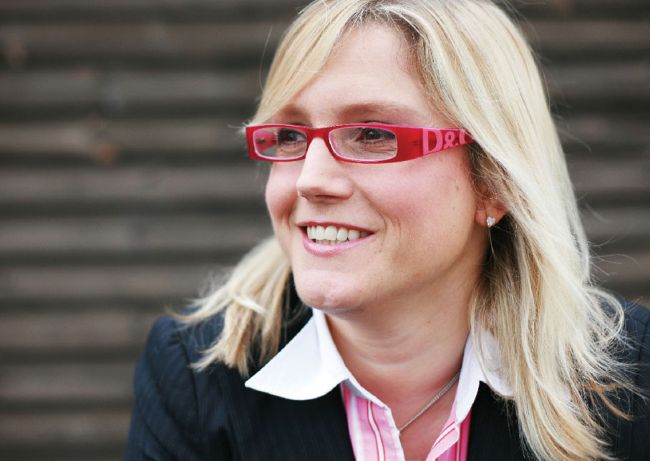
Sarah Graham: lesbian, intersex and proud
When my mother talks about her dead twin she says it’s as if she can still feel him pressed against her arm, as he was during the time they shared in their mother’s womb. When she told me how a doctor had left her sibling to die I was horrified. Her twin, Paul, was born intersex. The year was 1942. The medical protocol at the time, the legacy of which is still with us today, was brutal: because of his intersex variation – he was born with genitals which looked atypicalhe was wrapped in a blanket, left alone in a room for 24 hours, where he starved and cried to death.
The twins were six weeks premature, so keeping them both alive in a private house in rural Wiltshire without an incubator made the survival of one or both infants doubtful and difficult. In fact, my mother recalls, it took three months before they could say she would live.
“It was probably difficult under the circumstances to make a decision of letting one twin go so that the other would survive,” she explains. “After all, we weren’t in a hospital and I had to be fed for some weeks every two hours with a pipet. I am sure this influenced the decision to save me and let Paul‘go’. I have never thought of this as murder, rather that he was sacrificed so that I had a chance to live. But of course it was the doctor’s opinion of his genitalia which meant he didn’t survive.”
In the 74 years since my mother and her twin were born, the situation for intersex babies is little better. In some cases, intersex babies are terminated pre-natally based on tests that show healthy variable difference. “That’s pre-selective infanticide,” explains Holly Greenberry, co-founder of human rights organisation IntersexUK. Adding insult to injury, intersex people today are diagnosed with “disorders of sexual development” (DSD), a term coined around 10 years ago which has caused controversy, with its implication that what is naturally occurring should be considered a “disorder”.
According to intersex rights campaigners, the current estimate is that one in 200 babies is born with sexual characteristics – genitals, hormones, gonads and/or chromosome patterns – that don’t seem to fit typical binary definitions of male or female. Leslie Jaye, of intersex human rights organisation OII-UK tells me, “The plain fact is that nobody really knows because if we’re not caught at birth – many intersex people are identified in childhood, adolescence, or much later in life – some never are. Most people born intersex do not have variant external anatomies.”
Those born with intersex traits are grouped under the umbrella term intersex. These variations include androgen insensitivity syndrome, some forms of congenital adrenal hyperplasia (CAH), ovo-testicular syndrome, Klinefelter syndrome, Turner syndrome, hyperspadias and others. That said, 80% of intersex variations have no formal diagnosis at all. And, as Leslie Jaye explains, “these medicalised terms serve to frame intersex as a diagnosis rather than one of embodiment and lends credence to the pathologisation of intersex variation”.