The Fact of Fiction
Underworld
Revealing the secrets of the Doctor’s adventures – scene by scene.

The R1C travels through space on its seemingly endless quest to find the P7E in Underworld (1978).
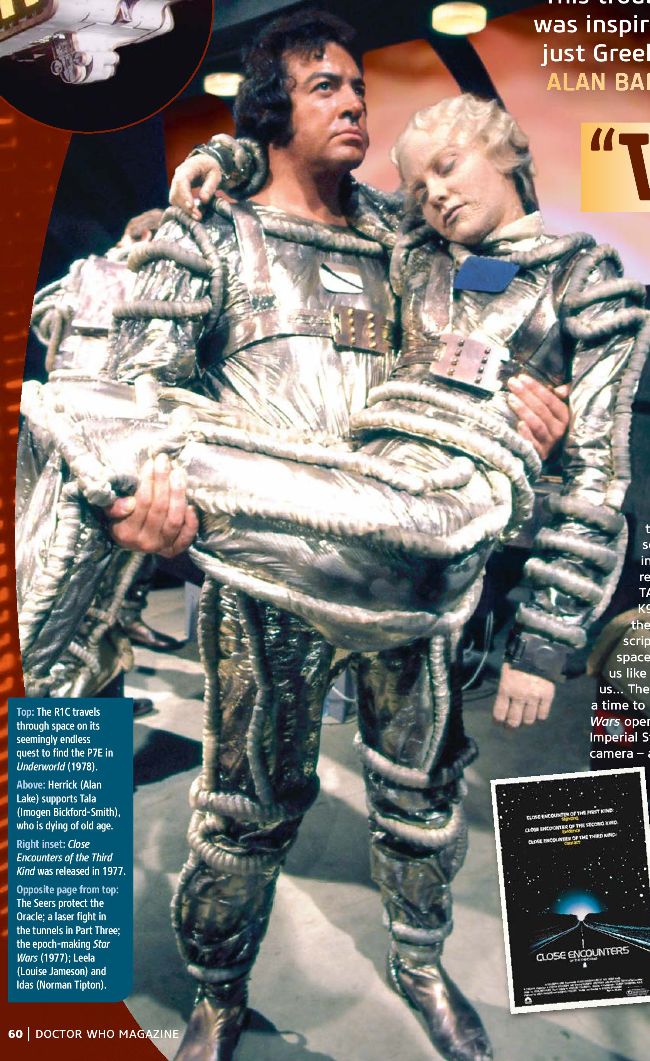
Herrick (Alan Lake) supports Tala (Imogen Bickford-Smith), who is dying of old age.
“We are not alone,” insists K9, when the TARDIS arrives at the edge of the universe in Part One of Underworld.
He then repeats the statement twice – so one suspects it’s probably no coincidence that ‘We are not alone’ was also a publicity tag for the movie Close Encounters of the Third Kind (1977), released in the UK on 13 March 1978, two months after Underworld first aired.
Steven Spielberg’s UFO saga had been the subject of much media anticipation in the summer and autumn of 1977 prior to its US debut in November – and its first trailer had concluded with the line.
Close Encounters wasn’t the American science-fiction sensation of 1977 referenced in Underworld, though. The reason why the occupants of the TARDIS aren’t alone is because K9 has detected a spacecraft in the vicinity: the R1C, described in scripted directions as a “multihull space vehicle” which “comes towards us like a giant ray. And passes over us… The ship is large and takes quite a time to pass over us…” Famously, Star Wars opens with a lengthy shot of a vast Imperial Star Destroyer passing over the camera – and although George Lucas’ space saga wasn’t released in the UK until 27 December, 11 days before the first episode of Underworld went out, members of the Doctor Who production team were granted a preview.
On the DVD commentary track for the serial, Tom Baker recalls that “The whole world had heard of Star Wars, and then finally the BBC heard about it, and because they’re not without influence, they got us a ticket, and a whole gang of us from Doctor Who – technicians and special effects people, and [producer] Graham Williams – and we all went in a crocodile, hand in hand, to Tottenham Court Road, and were smuggled in to see Star Wars.” Williams, he avers, was “overpowered by it, especially that opening sequence with the spaceship, which took about a minute and a half or something to cross the screen…”
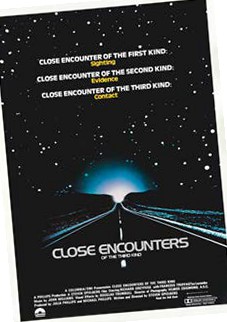
Close Encounters of the Third Kind was released in 1977.
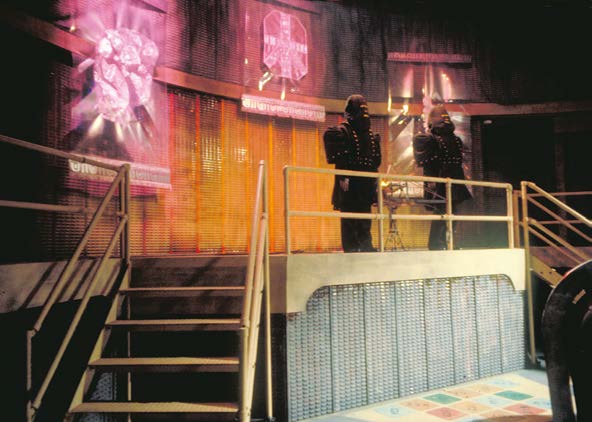
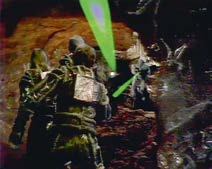
The Seers protect the Oracle; a laser fight in the tunnels in Part Three; the epoch-making Star Wars (1977); Leela (Louise Jameson) and Idas (Norman Tipton).
It’s absolutely the case that Star Wars caused the production team to up their game.
It’s probably coincidental that Underworld’s baddies wear flared black hoods, that there’s a ray gun fight above an abysmal drop, and that the whole thing ends with a planet-sized spaceship exploding. It’s absolutely the case that Star Wars caused the production team to up their game, as electronic effects designer AJ Mitchell recalled in the fanzine In Vision: “[Graham Williams] had seen the film, and wanted Underworld to look technically more sophisticated. So he fought for (and got) a gallery-only day, when just the technicians and the director could come in and do post-production work – adding beams and ray gun shots to tape and film that had already been recorded.”
Compare and contrast the aforementioned laser skirmish with the ‘as live’ video effects in The Invisible Enemy earlier in the same season, and it becomes obvious that Underworld represented a quantum leap for the programme.
Script editor Anthony Read; a scene in the tunnels realised using CSO; Diana Dors and her husband, Alan Lake.
But in part Underworld resembles an earlier sci-fi rival, too. The story builds on The War Games (1969), when the Time Lords finally convicted the Doctor of breaking their “most important law of non-interference in the affairs of other planets”. At last we learn what led to the establishment of that law, in the tale of the Minyan civilisation destroyed by the Time Lords’ clumsy intervention. Curious to note how that law resembles a similar principle established in Star Trek, which inherited Doctor Who’s BBC1 slot after The War Games.
Star Trek’s so-called ‘Prime Directive’ was first mentioned in the episode The Return of the Archons (first shown in the UK in 1969, repeated in 1974 and 1976) – one of a number of episodes concerning a malign machine intelligence. Like, for example, the Oracle in the episode For the World is Hollow and I Have Touched the Sky (first shown in the UK in 1971, repeated in 1973 and 1976). Like Underworld’s Oracle, it has a name from ancient Greek history, from the supposedly all-seeing Oracle at Delphi. It’s striking to note, however, that the same episode is set on an asteroid ship sent out into space from the doomed planet Fabrini 10,000 years earlier, whose latterday inhabitants, descendants of its original crew, eke out an entirely subterranean existence, mostly unaware of the existence of sky…
“The stars really exist, then?” the ‘Trog’ Idas asks on meeting the TARDIS tr avellers in Part Three.
“Of course they do,” replies Le ela. With Underworld, Do ctor Who was reaching for tho se stars… as best it could.
Essential INFO
•The fifth story of the 1977-78 season was one of the first commissioned by incoming script editor Anthony Read, who prompted writing partners Bob Baker and Dave Martin to seek inspiration in ancient Greek mythology.
• Inflation was Doctor Who’s recurring enemy throughout the mid-1970s. With the inflation rate averaging 15.8% throughout 1977, budgets that seemed adequate when the season entered production in the spring had become hopelessly stretched by the autumn.
With tunnel sets depicting the eponymous underground deemed unaffordable, it was decided to record all those sequences against model sets electronically keyed into the picture via Colour Separation Overlay.
• Norman Stewart, a Doctor Who production assistant as far back as the first Dalek serial in 1963-64, but more recently responsible for Baker and Martin’s similarly effects-intensive The Invisible Enemy, was hired to direct. The most notable guest actor was Alan Lake – a tabloid celebrity of the era, as the third husband of glamorous star Diana Dors. Like several members of the Underworld guest cast, he’d not long before guested in the Northern police procedural Z Cars – Graham Williams’ last assignment (as script editor) before becoming producer of Doctor Who.
• The cast worked entirely against blue drapes when tunnel scenes for Parts Two and Three were recorded across Monday 3 and Tuesday 4 October. TARDIS and R1C interiors were recorded on Saturday the 15th and Sunday the 16th, then the R1C sets were redressed to feature as the P7E in scenes recorded on Monday the 17th. With model shots having been pre-filmed at Bray Studios, production wrapped after recording of Part Four’s tunnel scenes on Tuesday the 18th – but electronic effects were added during the programme’s first ever ‘gallery only’ day on Friday the 21st.
• Underworld plumbed the depths in Doctor Who Magazine’s First 50 Years poll of 2014 – ranked 236th out of 241.