BAD WOOLF!
He was bound and imprisoned for all eternity, but rose again. Benjamin Cook joins the big dogs in studio, as Gabriel Woolf brings Sutekh’s gift of death to a whole new generation…
Sutekh actor Gabriel Woolf, with mini-me.
Down a quiet little passage in the shadow of the BT Tower, smack-bang in the middle of London W1, Sutekh the Destroyer is getting ready to rumble. It’s a Monday morning – 22 May 2023 – and the great Gabriel Woolf is on Berners Mews, visiting Bang recording studios, where he’ll be resurrecting the Lord God of Death Itself. He’s laying down his lines for Doctor Who’s 2024 season finale, two-parter The Legend of Ruby Sunday and Empire of Death. Probable trap: 100 per cent.
As chance would have it, Doctor Who filmed on this very spot 57 years ago to the day. On 22 May 1966, a War Machine trundled along Berners Mews, on its way to the BT (née Post Office) Tower. Londoners fled down this street. While three blocks away, in Bedford Square, the TARDIS loitered.
Waiting patiently for the day that Sutekh would seduce her.
“Sutekh is basically a spurned lover who’s never been able to let the Doctor go,” says Scott Handcock, Doctor Who’s script editor, who’s directing 90-year-old Gabriel today. “Literally, he’s been clinging to that TARDIS [since his original appearance, in 1975 classic Pyramids of Mars]. So there’s that kind of energy of someone seeing their ex after years and years, still completely hung up on them, and going, ‘Look what you missed out on.’ He’s relishing his triumph.”
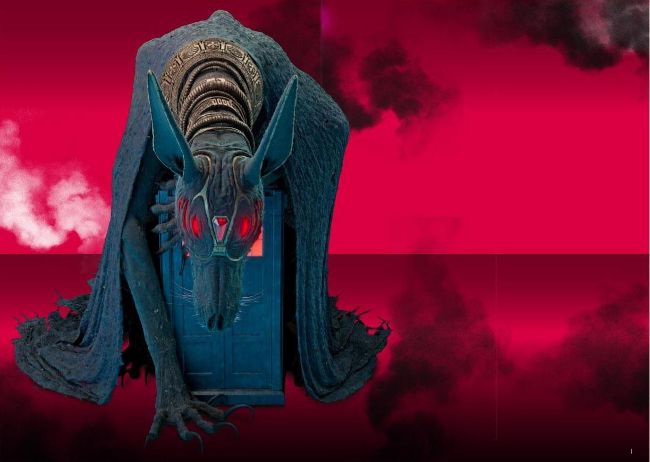
Gabriel was a sprightly 42-year-old when he last breathed life – and death – into Sutekh on TV. Back then, Sutekh was your everyday all-powerful alien boy from Phaester Osiris, harbouring ambitions to become a deity. But hasn’t he grown. Come 2024, Sutekh will have evolved into his true godhood: a gnashing, snarling, hairy colossus. Bad dog, Sutekh! BAD BOY!!! Gabriel, who voices him, has evolved too, into a whitehaired nonagenarian in a gilet and slacks. All life will perish at his hand.
“Sorry, who is Sutekh in love with exactly?” asks Gabriel, from his recording booth.
“The Doctor,” reiterates Scott, sat in the control room. Sutekh is all of us, Scott explains: hung up on Doctor
Who and clinging to the TARDIS for dear life. Call it puppy love.
“Yes, he’s obsessed, but I mean… he didn’t choose to be,” posits Gabriel, casting his mind back to Pyramids and the summer of 1911. “It was a situation he found himself in, sitting on this throne in a tomb when the Doctor came… no, it wasn’t the Doctor at first. It was this other man [Marcus Scarman], on an expedition.
“But when the Doctor stopped me [he trapped Sutekh in a time tunnel], I suppose I found him to be… not an equal, but at least worthy. Should I sound moderately like I did back then?”
“Yes, please,” says Scott, eagerly. “The purring and that. The quieter it gets, the more sinister it is.”
“Well, that’s my trademark,” says Gabriel, grinning. “I want it to be quiet and intimate and one-to-one. Not what you’d expect. I mean, I’ll scream when you want me to…”
Gabriel’s velvety voice is an impeccable fit for the last of the Osirans. “You’re born with it or you’re not born with it,” he tells me, “and I was very lucky.” Mind you, those rich, silky tones that won him the role in 1975 had been honed through years of radio work, too. When did Gabriel first realise that his voice was special? “I was a student at RADA. I was really quite young – too young, really – to be there. I was only about 18. There was a teacher who taught voice and poetry. We had a class where she passed around a book and we each had to read a poem at sight…